
Porcelain from the 18th century
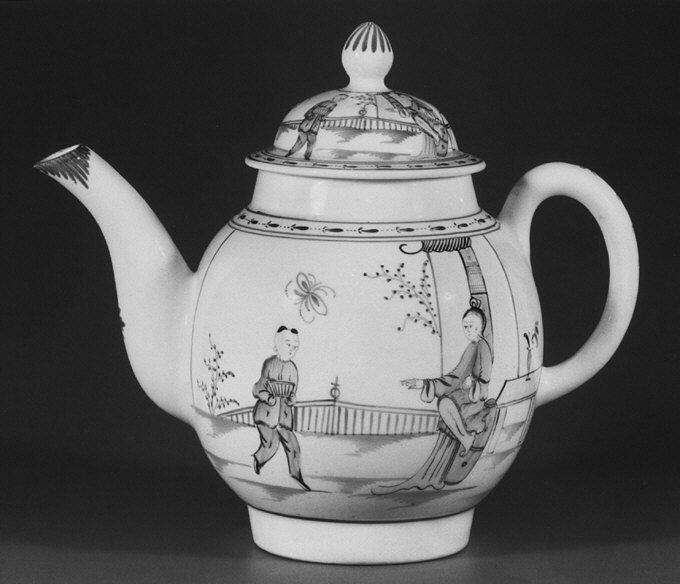
An exploration of experimental porcelain from the 18th century, it's a grand title but as you will hopefully read further this was a very small window in the history of ceramics, and relatively short lived, but one of intrigue, espionage and sabotage, fuelled by the need for a nice cup of tea and something fancy to drink it from.
In order to understano Lowestofts contribution to soft paste porcelain we need to look at the history of porcelain as a whole and explore how this material and this new industry first came to Britain and then to the east coast.
While studies and books have focused on the popularity of Lowestoft porcelain, the historical stories behino the wares and its intricate, hand painted designs, few have explored the material properties which make Lowestoft porcelain so unique.
Original Lowestoft porcelain still reaches very high prices and is considered highly collectible in some circles. Annual auctions are still organized by the Spake family.
Could this white gold be part of what this town needs something to shout about?
Cultural heritage and creative industries are the future of our high streets and our town centers. How have other towns celebrated their heritage and how is this different from a town's history. I would hope that this could form the basis of my future practice.
Lowestoft porcelain has an almost mythical air to it's story with the majority of English Potteries based in Stafforoshire what made Lowestoft porcelain so important and how did this little fishing town so separated from Staffordshire and the potteries in Stoke on Trent and how could they compete with these experts in their field. Lowestoft wasn't a traditional pottery, but it was at the forefront of a new technological breakthrough in the manufacture of porcelain or imitation porcelain. The difference in these l will go into more detail further on.
To understand the experimental nature of porcelain and in particular British Imitation porcelain of the mid 18th century its important to look at the history of this fine translucent material and what it actually is, and where it comes from.
The word porcelain has no equivalent in Chinese. There are simply two types of pottery, low and high fired ceramic wares. Within these two groups occur a great variety of wares which are either named after their place of origin or their unique appearance.
The plasticity of these wares made the use of casting techniques unnecessary whereas the plasticity of the white clay from Europe was very low and needed to be cast rather than traditional forming methoos.
The word porcelain has been used to describe many of these wares but was used specifically for the white and blue decorated wares from Jingdezhen.
Early imports of porcelain from China are recorded in Italy from as early as the 14th and 15th century, early examples of majolica (tin glazed earthenware) the influence of the Jingdezhen blue and white porceloin is very apparent.
Augustus the Strong, King of Poland and Elector of Saxony.
It was Augustus the Strong, King of Poland who finally provides a solution to the secret of true hard paste porcelain. With the arrest and imprisonment of the alchemist Johan Friedrich Bottger, whom after three years of failing to transmute base metals into gold, was set to work with Ehrenfried Walther, Count Von Tschirnhaus, a celebrated physicist. They carried out tests on earths and minerals to find their resistance to heat and their chemical changes at high heat. They developed a red stoneware called jasper, the name of a semi-precious stone.
After exhaustive experiments replacing the red clay with white clay, from Meissen Bottger, discovered Chinese porcelain in 1710. He founded the Meissen factory which is still in production today.
Sprimont and Chelsea.
The Chelsea factory was established in 1744 by Nicholas Sprimont, a former silversmith, with many of its early shapes cast from moulds taken from fine silverware. Amongst English porcelain only Chelase matched the quality of its European counterparts. Chelsea porcelain was aimed at the luxury markets.
Fake china.
Alongside Chelsea, was Bow, as the first factories to produce porcelain in any quantity. Bow was the first to produce soft paste porcelain or imitation porcelain as it was known. The Bow factory was actually based in Essex and they used the name of New Canton to boast of connection to China. All of Bows early wares were tablewares richly decorated with Chinese motifs and emblazoned with 'Made in New Canton. It may have been 'fake china' but they provided tableware for the mass market.
The Far East (of England).
With many traditional potteries based in Staffordshire, because of easy access to clay in the west and coal from the north via the new canals, how did a small herring fishing town on the most easterly part of the country become to be a part of this new industry of porcelain manufactory?
The answer to this could lie in the formula of soft-paste porcelain. Only a small amount of actual clay required to create these formulas. It is possible with most raw materials available nearby the only bulky commodity would be coal, which would have come down the coast from Hull to Great Yarmouth.
The sabotage of Hewling Luson.
Hewling Luson was the owner of the Gunton Estate in 1756 which now forms a part of North Lowestoft. Fine white clay was discovered on his estate and sent to the Bow factory for analysis. Reports came back that it was 'somewhat finer than that called delftware.
The story goes that Hewling Luson recruited some workmen from London to help with his experiments. They built a temporary kitn, but the workmen had been bribed and told to 'exercise every art in their power to render this scheme abortive'. His wares were spoiled and he later went bankrupt.
The man in the barrel.
After Hewling left the estate, a new tenant Philip Walker, moved onto the estate and formed a partnership with Obed Aldred, also a local kiln owner, with the intention of making porcelain wares. As they would have been aware of the fate of Hewlings experiments, and not wanting to fall into the same sabotage, they sent a blacksmith called Robert Browne to the Bow factory where he is reported to have hidden in a barrel to find the secret recipe.
This secret recipe was put to good use and although the factory was only in production for about forty years, that was much longer than its contemporaries.
The leaf that sparked a revolution.
The arrival in Britain of a new exotic drink called tea during the middle part of the 17th century changed the drinking habits of the country. Brought to England by the East India Company it was expensive and needed unfamiliar equipment to prepare and drink it. The social importance of tea drinking and the birth of the middle classes with their desire to emulate the aristocracy created a whole new ceramics industry and created the need for caddies, spoons, tea tables and trays along with teapots and cups. The heavier earthenware cups and pots made by traditional European pottery methods at the time were unsuitable and the British public wanted porcelain.
The Chinese exports of their delicate and finely decorated plates and bowels were the envy of European potters and earthenware manufacturers. For centuries European potters had tried to emulate the beautiful, lightweight and translucent porcelain wares imported from China. The growing fashion of tea drinking was ample encouragement for British and European potters to discover the secret for making porcelain themselves.
Translucency and whiteness.
Porcelain and bone china are sometimes classed as 'one and the same' material.
It may be easier and may be more correct to refer to them as hard paste porcelain with bone china being a part of the soft paste porcelain family. There are some big differences that distinguish them from each other both historically and technically. Whilst they have some of the same ingredients and characteristics in common the differing ingredients, recipes, shrinkage rates and firing temperatures highlight and contribute to their individual qualities. While both possess translucency and whiteness there are some subtle differences concerning their properties. Hard paste porcelain tends to be warmer with tones of white, ranging from creamy off white through to blueish white. Bone china or soft paste porcelain on the other hand tends to be ice white or cold in colour unless it has been under fired, then it can take on a pinkish hue.
Formulas.
Many books and articles have been written about Lowestoft porcelain with many tackling the historical importance and its far reaching popularity, with its wares often depicting a glimpse of local historical events and others focusing on the intricate hand painted imagery mimicking the classic images from the blue and white porcelain from Jingdezhen, but few offer an exploration of the formula that gave it its unique quality.
There is no contemporary formula for Lowestoft porcelain. Starting with a data analysis from an archaeological dig in 1906 and by looking at other recipes from the era l pinpointed a few experiments from the data.
Report on the scientific examination of a lump of white material found on the Lowestoft porceloin factory site.
1. introduction.
The Lowestoft porcelain factory used bone-ash paste seemingly very similar to that of Bow. it was thought that this lump of white material might be a sample of the unfired body of Lowestoft porcelain.
2. The nature of the white material.
X-ray analysis of a sample of the white material confirms the presence of bone ash. Chemical analysis showed the material contained silica, alumina and phosphate with small amounts of lime, magnesium soda and potash. Microscopic examination suggests the silica was added as ground flint rather than sand.
3. conclusion.
These analyses confirm that this is a sample of unrefined bone-ash porcelain body. However it should be noted that the material may have been contaminated during burial and also that it may not represent the body in its final state.
This analysis establishes the two main ingredients in Lowestoft porcelain were bone-ash and silica, the latter probably obtained from crushed flint.
Lowestoft porcelain 2000.
In 2001 Lowestoft porcelain 2000 was launched by Peter Knight as a new venture two centuries after the close of the original factory. Creating designs based on traditional Lowestoft heritage and also modern designs. This new ware reproducing and creating the traditional essence of 18th century designs using traditional hand painted techniques.
The wares produced by Lowestoft porcelain 2000 in the heritage style included tea sets, caddies, bowls, plates and jugs, hand decorated in blue and white.
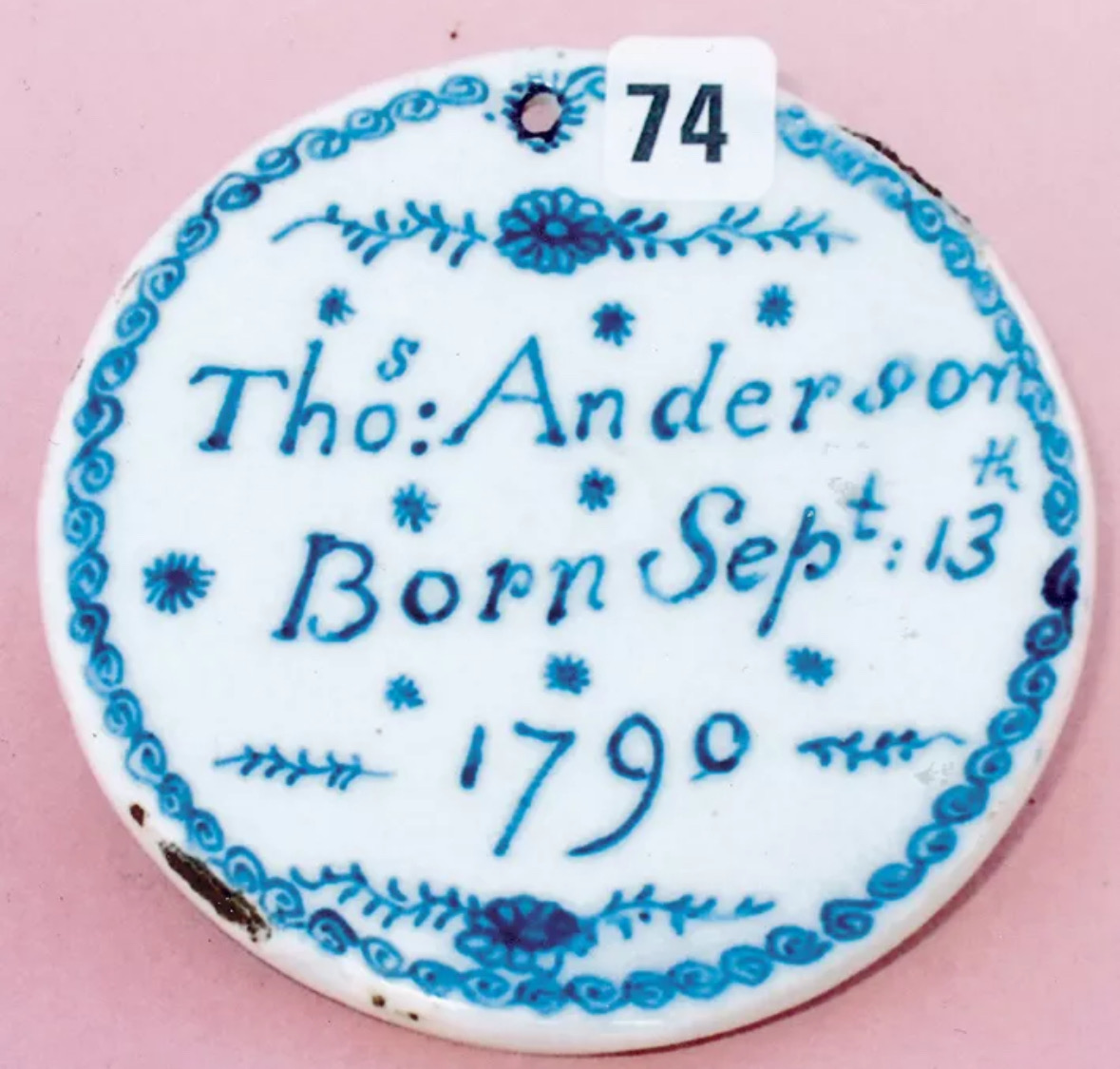
The original birth tablets, unique to Lowestoft, were also reproduced once more and individually decorated to order. Lowestoft porcelain 2000 and the dedicated research of Peter Knight certainly created another chapter in the Lowestoft porcelain story. Although no longer in production many of these wares are collectible in their own right and are excellent examples of hand painted wares.
First lamp light.
With changes in society and the way we eat moving away from formal dining has been happening for many years and in many homes has been long gone. The material porcelain, or imitation porcelain, with its translucency lends itself to lighting. And while l'm quite certain Lowestoft porcelain didn't produce lamp shades, maybe that could be the future for the Lowestoft porcelain material development. Lowestoft has the first light of the day, being fortunate to be the most easterly town, maybe the future og Lowestoft porcelain is to focus on the material and its translucency, and to view it in a contemporary setting. With so many beautiful and historic buildings laying empty in Lowestoft let's hope that over the next few months and years we can build something that will bring our creative heritage back to the High Street. CREDIT: Tim Cross
Photo CREDIT: metmuseum.org
Comments
Are you aware of the Factory…
Are you aware of the Factory’s significance in terms of its late 18th century presence in the town and its role in helping to foster Lowestoft’s development as a place of resort? This, by way of diversification from the main traditional economic pursuits of fishing and maritime trade and something very much in line with other contemporary coastal “watering places”.
And, just another additional local comment: Philip Walker’s kiln at Gunton was one which produced bricks and tiles and Obed Aldred was a builder-brickmaker who had a kiln on Skamacre Heath (Normanshurst-High Beech area). Walker actually lived in the Georgian house, now known as “Kingsmead” (No. 122 Yarmouth Road).
Finally, the East Coast coal export trade was mainly southwards from out of Newcastle-on-Tyne down to London - and Lowestoft had been a dropping-off point since at least the beginning of the 16th century (references made in the Newcastle Chamberlains’ accounts) and probably earlier.
All the best,
David Butcher
Add new comment