
Subscription Lists for Rebuilding of Town Chapel & Chamber
Money Received by Captain Andrew Leake towards the Rebuilding of the Chapel (1698)
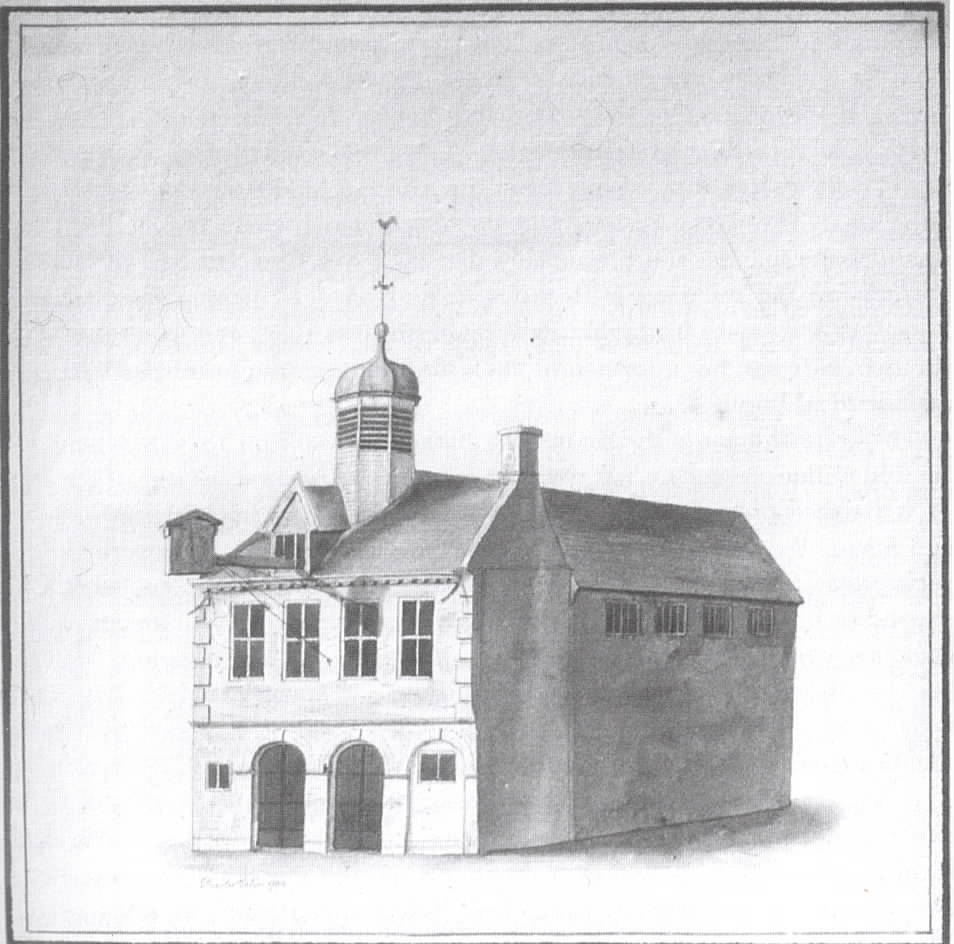
An ink-and-wash study of the Town Chamber, with Chapel to the rear, executed by Richard Powles in 1784. To be found in the Isaac Gillingwater collection of local illustrations c. 1807 - Suffolk Archives, Ipswich, 193/2/1.
| £ | s | d | £ | s | d | ||
| Mr. John Wilde | 10 | - | - | Brought forward | 124 | 7 | 0 |
| Mr. Thomas Ashby | 10 | - | - | Francis Canham | - | 2 | 6 |
| Captain Leake’s own Gift | 10 | - | - | Widow Betts | - | 5 | - |
| Mr. John Jex | 8 | - | - | Mrs. Alice Wilde | 1 | 2 | - |
| Mr. James Wilde | 5 | - | - | Mrs. John Hovell | 1 | - | - |
| Mr. Thomas Starff | 5 | - | - | John Postle | 1 | - | - |
| Mr. John Wilde Junr. | 5 | - | - | Mrs. Mary Pacy | - | 10 | - |
| Doctor Joseph Peake | 8 | - | - | Mrs. Mary Knights | 1 | 2 | - |
| Mr. Matthew Arnold | 5 | - | - | Ann Buskard | - | 2 | 6 |
| Mr. William Rising | 4 | - | - | Mrs. Margaret Wilde | 1 | - | - |
| Mr. Nicholas Utting | 4 | - | - | Mrs. Ann Durrant | - | 5 | - |
| Mr. Thomas Mighells | 2 | - | - | Mrs. Ann Wells | - | 5 | - |
| Mr. Joseph Smithson | 2 | - | - | Mrs. Alice Munds | - | 10 | - |
| Mr. John Stannard | 2 | - | - | John Cosens | - | 10 | - |
| Mr. John Barker | 5 | - | - | Francis Seamons | - | 10 | - |
| Mr. John Hayle | 1 | 2 | - | Michael Thurston | - | 10 | - |
| Mr. Benjamin Ibrooke | 1 | 10 | - | Thomas Spratt Junr. | - | 5 | - |
| Mr. John Hayward | 5 | - | - | Alice Knights | - | 1 | - |
| Mr. John Stroud | 2 | - | - | Ann Spratt | - | 1 | - |
| Mr. Simon Canham | 1 | - | - | Mr. Haward’s Son & Daughter | - | 5 | - |
| Simon Landefield | - | 5 | - | Mrs. Deborah Leake | - | 5 | - |
| John Smith | - | 5 | - | Sarah Ravens | - | 1 | - |
| Thomas Spratt | 2 | - | - | Elizabeth Peirson | - | 1 | - |
| John Wooden | 1 | - | - | Elizabeth Mouse | - | 1 | - |
| Nathaniel Long | 1 | - | - | Susanna Fearney | - | 10 | - |
| Mr. Spencer Bretton | 2 | - | - | Rachael Love | - | 2 | - |
| William Mouse Junr. | 1 | - | - | Francis Annison | - | 1 | - |
| William Manthorp | 2 | - | - | John Smith | - | 1 | - |
| Samuel Kittredge | 1 | 10 | - | Samuel Peake Junr. | - | 1 | - |
| John Mewse | - | 10 | - | George Boyce | - | 2 | - |
| Mr. John Bishop | 2 | - | - | George Gleadhill | - | 5 | - |
| Robert Baker | 1 | - | - | John Anderson’s wife | - | 1 | - |
| Mr. Thomas Utting | 2 | - | - | Ann Sherington | - | 1 | - |
| William Peake | - | 10 | - | John Barrett | - | 2 | 6 |
| Daniel Long | - | 10 | - | Richard Kemp Junr. | - | 2 | 6 |
| Mr. James Gifford | 2 | - | - | Stephen Tripp | - | 1 | - |
| Thomas Fulcher | 1 | - | - | Of several persons | - | 10 | - |
| William Steeres | - | 5 | - | Mrs. Susanna Peake | - | 10 | - |
| Thomas Felton | - | 10 | - | Elizabeth Freary | - | 1 | - |
| Samuel Barret | - | 10 | - | Francis Kittleburgh’s wife | - | - | 6 |
| Mr. John Peale | 4 | - | - | Samuel Darkin | - | 2 | - |
| Mrs. Rivet Widow | 2 | - | - | James Spicer | - | 2 | 6 |
| Carried forward | 124 | 7 | 0 | Carried forward | 137 | 7 | 0 |
• All of the monetary accounts in this article are in the same elegant handwriting, written up from original documentation which probably no longer exists. They are to be found in the Lowestoft Town Book (pp. 55-7 & 67-8), a compendium of different matters relating to the town entered by various leading citizens at different times. This volume, along with other material, is housed in the Norfolk Record Office (this being the repository for Norwich Diocese parochial material) as item PD 589/112, and Suffolk Archives (Ipswich) holds a microfilm copy.
• Andrew Leake, son of a Lowestoft merchant, was temporarily out of a Royal Navy command at this time and spent his time in helping to raise money (by public subscription) for rebuilding of both the Town Chapel and Town Chamber, which stood adjoining each other on the site of what is now Lowestoft Town Hall. He went on to become one of Lowestoft’s greatest and most famous Naval commanders.
• Variant spelling is evident among the surnames – the most notable examples being Peake (Pake), Kittredge (Ketteridge), Cosens (Cousins), Haward (Hayward), Peirson (Pearson), Mouse (Mewse), Fearney (Ferney), Gleadhill (Gledhill), Freary (Frary) and Kittleburgh (Kettleborough).
• The use of Mr. (Master) and Mrs. (Mistress) indicates those people seen as being leading citizens in the local community.
The Account continued of the Money received by Captain Andrew Leake towards the Rebuilding of the Chapel
| £ | s | d | £ | s | d | ||
| Brought forward | 137 | 7 | 0 | Brought forward | 140 | 2 | 0 |
| Stephen Corfen | - | 2 | 6 | Margaret Pearson | - | 2 | 6 |
| Bridget Day | - | 1 | - | Widow Freary | - | 3 | - |
| Elizabeth Barker | - | 1 | - | William Botswain | - | 5 | - |
| Mrs. Elizabeth Haws | - | 3 | - | Thomas Tillney | - | 2 | 6 |
| Robert Tripp | - | 2 | 6 | Widow Landafield | - | 1 | - |
| Thomas Tripp | - | 2 | 6 | James Haws | - | 10 | - |
| Susanna Cockram | - | - | 6 | Richard Brown Junr. | - | 10 | - |
| Philip Fisher’s wife | - | 1 | - | James Mays | 1 | - | - |
| Mrs. Harwood | - | 2 | 6 | Francis Adams | - | 15 | - |
| Mrs. Alice Spratt | - | 5 | - | Samuel Adams | - | 10 | - |
| Mrs. Alice Durrant | - | 10 | - | James Mendham | - | 5 | - |
| Widow Munds | - | 5 | - | John Buxton | - | 5 | - |
| Thomas Munds | - | 2 | 6 | Jonathan Belgrave | - | 2 | 6 |
| James Spratt | - | - | 6 | Thomas Spratt Junr. | - | 2 | - |
| Widow Partridge | - | 1 | - | Elizabeth Pacy | - | 5 | - |
| Widow Long | - | 2 | 6 | 145 | 0 | 6 | |
| Richard Kemp Snr. | - | 1 | - | Received of Mr. William Wells | 7 | - | - |
| John Wilson | - | 1 | - | ||||
| John Colton | - | 10 | - | Total | 152 | - | 6 |
| Carried forward | 140 | 2 | 0 |
• Variant surname spelling continues as Corfen (Corfin), Haws (Hawes), Partridge (Patteridge), Freary (Frary), Botswain (Botson), Tillney (Tilney) and Landafield (Landefield/Landifield).
Money Disburst by Captain Leake towards the Rebuilding of the Chapel Etc.
| To Cash paid Robert Dixon as by his Bills and Receipts appear | 31 | 11 | 2 |
| To Cash paid Peter Paine and Robert Sherrington as p Bills & Receipts | 24 | 11 | 7 |
| To Cash paid Samuel Barret as pr. [per] Bills and Receipt | 10 | 16 | 6 |
| To Cash paid Mr. John Jex as pr. Receipt | 12 | 4 | 6 |
| To Cash paid William Colby as pr. Receipt | 3 | 16 | 0 |
| To Cash paid John Cossens as pr. Receipt | 1 | 5 | 4 |
| To Cash paid Robert Hullock as pr. Receipt | 2 | 6 | 0 |
| To Cash paid Edward Pressly as pr. Bill and Receipt | 1 | 5 | 0 |
| To Cash paid John Wroth as pr. Bill | 0 | 13 | 4 |
| To Cash paid John Youell as pr. Bill etc. | 0 | 19 | 4 |
| To Cash paid Edward Grimpston for bringing the Newcastle stones [sandstone blocks] ashore as pr. Bill | 0 | 2 | 0 |
| To Cash paid Mr. Thomas Woodroofe as pr. Bill | 10 | 0 | 0 |
| To Cash paid Richard Tonkes the plumber as pr, Bill and Receipt | 6 | 6 | 6 |
| To Cash paid Christopher Jackson as pr. Bill | 0 | 11 | 8 |
| To Cash paid Mr. Joseph Smithson as pr. Bill and Receipt | 3 | 5 | 3¾ |
| To Cash paid Thomas Spratt for deals | 2 | 0 | 0 |
| To Cash paid Doctor Peake for bricks | 3 | 0 | 0 |
| To Cash paid Mr. John Wilde for timber | 2 | 10 | 0 |
| To Cash paid Mr, John Day for deals | 0 | 12 | 6 |
| To Cash paid Edward Custens and Robert Arther for Carriage of lime | 1 | 11 | 8 |
| To Cash paid the Workmens allowance and Beer to the Carters etc. | 0 | 11 | 10½ |
| To Cash paid the Workmen and Labourers at taking down the old Chapel as pr. Bill | 4 | 13 | 7 |
| To Cash paid to Doctor Peake to Balance | 20 | 7 | 1¾ |
| To Cash paid Mr. William Wells | 7 | 0 | 0 |
| 152 | 0 | 6 |
This account was seen and audited and the Accomptant [Accountant] Discharged in the presence of | Thomas Ashby |
| John Wilde | |
| John Jex |
• Variant surname spelling in this section: Barret (Barrett), Cossens (Cousins), Prseley (Pressly) Grimpston (Grimston), Woodroofe (Woodroff), Peake (Pake), Custens (Custance) and Arther (Arthur).
• Occupations can be given for the following people referred to above, using various other documentary sources of the time (especially the parish registers and probate material). Robert Dixon (carpenter), Peter Paine (mason), Robert Sherrington (mason), Samuel Barret (brickmaker), John Jex (merchant), John Cossens (carter), Robert Hullock (yeoman), John Wroth (mariner), Edward Grimston (innkeeper), Joseph Smithson (merchant), Thomas Spratt (fisherman/mariner), John Wilde (merchant, styled gentleman), John Day (innkeeper) and William Wells (brewer & innkeeper).
• Newcastle stones were sandstone blocks used in building. They probably formed the arcading of the corn-trading area below the Town Chamber and the quoining (i.e. cornerstones) of its façade at first-floor level. It is likely that they had been brought down from Newcastle on a vessel involved in the London coal trade. Lowestoft had been a stopping-off place for this traffic since at least the beginning of the 16th century – but local craft themselves also brought coal home from the Tyne.
• The plumber would have been occupied in carrying out lead-work on the roofing and other parts of the two buildings, rather than anything to do with piped water-supply. This, as we know it, did not exist. Wells provided everyone’s water.
• Deals were softwood (pine, fir or spruce) planks used as flooring. They were often imported into Lowestoft from the Baltic.
• The lime referred to was used to make mortar and plaster.
Money received by Doctor Joseph Peake towards the rebuilding of the Chapel A.D. 1698
| £ | s | d | £ | s | d | ||
| Received the Ballance of | Brought forward | 110 | 10 | 7¾ | |||
| Captain Leake’s account | 20 | 7 | 1¾ | Alice Browne | - | 2 | 6 |
| Mr. Martin Browne | 50 | 0 | 0 | Robert Press | - | 5 | - |
| John Smith | - | 5 | - | Mr. John Peake | 1 | - | - |
| Simon Mewse Junr. | - | 5 | - | James Postle | - | 2 | 6 |
| William Peeke | - | 5 | - | Mr. Samuel Church | 1 | 1 | 6 |
| George Frances | - | 1 | - | John Landefield | - | 2 | 6 |
| Widow Grave | - | 1 | - | Nicholas Buckel | - | - | 6 |
| Mr. John Barker Junr. | 2 | - | - | Henry Fisher | - | 2 | - |
| Roger Haward | - | 5 | - | John Canham | - | 2 | - |
| Ruth Mewse | - | 10 | - | John Wroth | - | 1 | - |
| Mr. Borrett | 1 | - | - | John French | - | - | 6 |
| Mr. Simon Canham | 1 | - | - | Joseph Spratt | - | 2 | 6 |
| Mr. Stephen Hawes | 2 | - | - | Widow Long | - | 1 | - |
| John Pacy Snr. | 1 | - | - | James Kingsborow | - | 5 | - |
| Anthony Barlo | 2 | - | - | Widow Brimmer | - | 2 | - |
| Mr. John Wilde | 5 | - | - | Richard Reade | - | 5 | - |
| Mr. Thomas Mighills | 2 | - | - | A certain person | - | 1 | - |
| Henry Ramsdale | - | 5 | - | Thomas Mewse | - | 5 | - |
| Mr. John Barker Snr. | 2 | 10 | - | Thomas Bankes | - | 2 | 6 |
| Mr. William Rising | 2 | - | - | Bartholomew Pierson | - | 2 | 6 |
| Mr. John Aldred | 10 | - | - | Mr. Thomas Starff } | |||
| Samuel Clarke | - | 2 | 6 | and James Downing } | 2 | - | - |
| Margaret Maning | - | 1 | - | Francis Annison | - | 2 | 6 |
| Margaret Sterry | - | 1 | - | Mr. John Barker Junr. | - | 10 | - |
| James Hawker | - | 3 | - | Francis Spencer | - | 2 | 6 |
| Elizabeth Borrett | - | 5 | - | Mr. John Smithson | 1 | 10 | - |
| Mrs. Fearney | - | 5 | - | William Wattson | - | 5 | - |
| Mrs. Manthorp | 1 | - | - | Mr. Utting | - | 5 | - |
| William Botswain | - | 2 | 6 | John Willson | - | 5 | - |
| George Gleadhill | - | 5 | - | Samuel Hetch | - | 10 | - |
| Nicholas Spratt | - | 1 | - | Mr. James Ward | 2 | 4 | - |
| Thomas Spratt | -1 | - | Mr. Nicholas Utting Junr. | 1 | 2 | - | |
| Robert Grave | - | 2 | - | Mr. Reeve | 2 | 4 | - |
| Mr. Thomas Ashby | 5 | - | - | Mr, Scambler | 5 | - | - |
| Thomas Tilney | - | 1 | - | Captain Nicholson | 5 | 10 | - |
| Carried forward | 110 | 9 | 7¾ | Carried forward | 136 | 6 | 1¾, |
• Variant surname spelling in this section: Browne (Brown), Frances (Francis), Haward (Hayward), Barlo (Barlow), Mighills (Mighells), Maning (Manning), Fearney (Ferney), Manthorp (Manthorpe), Botswain (Botson), Gleadhill (Gledhill), Peake (Pake), Landefield (Landifield), Buckel (Buckle), Kingsborow (Kingsborough), Reade (Read), Bankes (Banks), Pierson (Pearson), Starff (Staff), Wattson (Watson), Willson (Wilson) and Hetch (Hatch).
• Martin Browne was a well-known Rotterdam merchant, with Lowestoft origins, who kept in touch with his roots via his Wilde family cousins.
The Account Continued of the Money received by Doctor Joseph Pake towards the Rebuilding of the Chapel
| £ | s | d | £ | s | d | ||
| Brought forward | 136 | 6 | 1¾ | Brought forward | 147 | 10 | 7¾ |
| Simon Tills | - | 2 | 6 | Robert Dixon | - | 5 | - |
| Thomas Holeran | - | 2 | 6 | Doctor Peake | 4 | - | - |
| William Colby and Thos Leake | - | 6 | 6 | Mr. Mathew Arnold | 2 | - | - |
| Andrew French | - | 1 | - | Mr. Woodroofe | 1 | - | - |
| William Smith | - | 2 | 6 | William Tillmouth | - | 10 | - |
| Mr, Nicholas Utting Snr. | - | 11 | - | Samuel Pacy Esq. | 10 | - | - |
| Mr. John Haward | 2 | - | - | Mr. Carleton | 8 | 8 | 6 |
| Thomas Fowler | - | 6 | - | Mr. John Pacy | 5 | - | - |
| Thomas Freary | 1 | - | - | Mr. Thomas Walesby | 3 | - | - |
| Thomas Bourn | - | 5 | - | Mr. John Jex | 2 | - | - |
| Thomas Kittredg[e] | - | 5 | - | 183 | 14 | 1¾ | |
| John Freary | 1 | 10 | - | Received of Mr. John | |||
| Mr. Thomas Utting | - | 10 | - | Hayle he Collected | 10 | - | - |
| John Kittredg[e] | - | 2 | 6 | Memorandum that Mr | |||
| Peter Paine | - | 10 | - | Samuel Munds gave in | |||
| Captain Leake | 3 | - | - | Money and Goods | |||
| Towards the Rebuilding | |||||||
| Carried forward | 147 | 10 | 7¾ | Rebuilding of the Chapel | |||
| which was omitted to be | |||||||
| inserted in due place | 9 | - | - | ||||
| Mr. John Smith discounted in his Bills for goods received for the use of the Chapel being his free gift | 5 | - | - | ||||
| Mr. William Whiston paid John Newton for finishing the Wainscot his Gift of | 5 | - | - |
• Variant surname spelling in this section: Haward (Hayward), Freary (Frary), Bourn (Bourne), Kittredg (Ketteridge), Woodroofe (Woodroff), Tillmouth (Tilmouth), Carleton (Carlton) and Walesby (Walsby).
• Mr. Carleton was Edward Carleton, Vicar of Lowestoft (1691-8).
• William Whiston was his successor from 1698-1702, before moving on to succeed Isaac Newton as Professor of Mathematics at Cambridge University. During his short incumbency, he made quite an impact on the town – particularly in the way that he formed a good working relationship with the town’s Nonconformist community.
Money Disburst by Doctor Joseph Peake towards the Rebuilding of the Chapel
| £ | s | d | |
| To Cash paid Mr. William Arnold as pr. Bill and Receipt appears | 15 | 3 | - |
| To Cash paid John Blaque | 4 | 7 | - |
| To Cash paid Edward Grimpston for bringing the Newcastle stones ashore | - | 4 | 7 |
| To Cash Paid Peter Pain the Mason as pr. Bill & receipts | 22 | 3 | 7 |
| To Cash paid Edward Presly the saw[y]er | 3 | 18 | 2 |
| To Cash paid Joseph Newton the Joyner as pr. Bills & receipts | 30 | 6 | 9 |
| To Cash paid Thomas Spratt for Newcastle Stones as pr. Bill & Receipt | 5 | - | 6 |
| To Cash paid Robert Dixon the Carpenter as pr. Bills & receipts | 14 | 18 | 4 |
| To Cash paid Mr. Wilde for timber for windows | 5 | - | - |
| Cash paid John Cossens as pr. Receipt | 2 | 18 | 7 |
| To Cash paid John Orris for six bunches of hard larth | - | 15 | - |
| To Cash paid Samuel Barret as pr. Bill & Receipt | - | 9 | 6 |
| To Cash Paid Simon Hollady for twenty bunches of Firre larth | 1 | - | - |
| To Cash paid Mr. Baker for hair | 1 | 16 | - |
| To Cash paid Thomas Leak and William Colby as pr. Bill etc. | 7 | 6 | 6 |
| Carried forward | 115 | 7 | 6 |
• Variant surname spelling in this section: Blaque (Blake), Grimpston (Grimston), Pain (Payne), Presly (Presley), Cossens (Cousins), Barret (Barrett), Hollady (Holliday) and Leak (Leake).
• Occupations known (other than those given) were as follows: William Arnold (Brewer), John Blaque (parish clerk), Edward Grimpston (innkeeper), Thomas Spratt (fisherman/mariner), John Cossens (carter), Samuel Barret (brickmaker), Simon Hollady (mason) and Mr. Baker – possibly, either Robert or Samuel – (both customs officers).
• It seems that Thomas Spratt (mariner) may have purchased and conveyed the Newcastle stones himself.
• The two types of lath (larth) referred to were used to construct lath-and-plaster walls and ceilings, with the wood split down the length of the grain to produce the narrow strips required to take the lime-plaster infill – three coats of which were usually applied. The hardwood used was mainly oak, sweet chestnut or lime, while home-grown larch was sometimes used for the softer kind, as well as pine, fir or spruce. The hard lath tended to be the material for walls, while the lighter type served for ceilings.
• The hair referred to was from animals (mainly horses and cattle), being mixed into mortar to act as a binding agent. The reddish-brown coat of Suffolk’s native Red Poll cow was often used – as revealed in the 17th century ceiling saved from demolition of a Stoven farmhouse and later re-set in a ground-floor room of the Lowestoft Heritage Workshop Centre. If either of the customs officers named above had been involved in its supply, it is difficult to see what the connection may have been.
The Accounts continued of the Money Disburst by Doctor Joseph Peake towards the Rebuilding of the Chapel
| £ | s | d | |
| Brought forward | 115 | 7 | 6 |
| To Cash paid for 400 and ½ of bricks | - | 9 | - |
| To Cash paid Mr. John Haward for Newcastle stones | 1 | 15 | - |
| To Cash paid Thomas Frarey as pr. Bill and receipt | 4 | 9 | - |
| To Cash paid John Frarey as p Receipt | 4 | 5 | - |
| To Cash paid Mr. Thomas Utting as p Bill and receipt | 3 | - | 8 |
| To Cash paid for a Doss for the pulpit | - | 1 | - |
| To Cash paid Thomas Fello[w] for carrying the rubbish from the Cross | - | 1 | 6 |
| To Cash paid Dinah Cook for cleaning the School Chamber | - | - | 6 |
| To Cash paid Mr. John Smith as p Bill | 1 | 9 | 10 |
| To Cash paid for three Matts for the desks | - | 2 | - |
| To Cash paid for five pounds of candle | - | 2 | 2 |
| To Cash paid Richard Ellis the Glazier as p Bill & Receipt | 5 | 12 | 6 |
| To Cash paid Mr. Thomas Woodroof for Lime as p Bill & receipt | 9 | 6 | - |
| To Cash paid Mr. John Youell for freight of lime | - | 10 | - |
| To Cash paid John Gardener as p Bill and receipt | 4 | 9 | - |
| To Cash paid Mr. Wilde to Balance his Account | - | 12 | - |
| To Cash paid Mr. Henry Ward as p Bill and receipt | 13 | 10 | - |
| To Cash paid Mr. Watson as p Bill and receipt | 1 | 10 | - |
| To Cash paid Thomas Herring as pr. Bill | - | 5 | - |
| To Cash paid Mr. Harwood towards the pulpit Cloth and Cushion | 1 | 7 | 6 |
| To Cash paid Mr. John Jex as p Bill and receipt | 15 | 12 | - |
| To Cash paid to Robert Hulock for cartage | - | 2 | - |
| To Cash paid Mr. John Farr as p Bill | 1 | 5 | - |
| To Money spent and putting out the work and Workmens allowance etc. | - | 6 | 3 |
| To postage of Letters to Holland Ireland and other places | - | 2 | 8 |
| To Cash paid Mr. John Hayle as p Bill and receipt | 10 | - | - |
| 195 | 13 | 1 | |
| 193 | 14 | 1¾ | |
| Rest due to this accountant to balance whichever | 1 | 18 | 11¾ |
Accountant freely dischargeth the town of
This account was seen and audited and the Accountant
Discharged in the presence of us
| James Wilde | John Wilde | John Barker Junr. | |
| John Jex | Matthew Arnold | ||
| Henry Ward | Joseph Smithson | ||
| John Barker | John Pake |
• Variant surname spelling in this section: Haward (Hayward), Frarey (Frary), Fello (Fellow), Woodroof (Woodroff), Gardener (Gardner), Hulock (Hullock) and Hayle (Hale).
• Occupations known, other than those given, as follows: John Hayward (mariner & merchant), Thomas Frary (blacksmith), John Frary (blacksmith), Thomas Utting (grocer), Thomas Fellow (fisherman), John Smith (mariner?), John Jex (merchant), Robert Hulock (yeoman) and John Hayle (grocer). The Mr. Watson referred to may have been William Watson (mariner).
• The doss referred to would have been some kind of cushion .
• The Cross mentioned was the arcaded corn-trading area below the Town Chamber. During Late Medieval times, it had originally been a market cross.
• The Town Chamber was used during the day to accommodate the town’s Free Grammar School.
• The three mats would have been for the three-decker pulpit in the Town Chapel. The bottom level was where the Parish Clerk read out public notices before the Sunday service began; the next one up was where the Bible lessons were read to the Congregation (mainly by the Minister and sometimes by the Clerk, but with Gospel passages always done by the former); and the top one was where the Minister delivered his sermon.
• Tallow candle, made largely from sheep-fat, was always reckoned and priced in terms of its weight. Thus, the five pounds purchased here (for use in the Town Chapel) for the sum of 2s 2d comes out as just over 5d per pound.
• The pulpit cloth and cushion were also for use in the Town Chapel.
• The letters to Holland would have been connected with Martin Browne making the largest donation (by far) of £50. The other correspondence cannot be accounted for.
Lowestoft October 28th 1706.
We whose names are hereunto Subscribed do hereby promise to pay the respective sums underwritten unto Mr. John Pake and Mr. John Stannard for and towards the Rebuilding of the Chapel.
| £ | s | d | |||||
| Money received | £ | s | d | Brought forward | 9 | 6 | 6 |
| Mr. Robert Briggs | 4 | - | - | Mr. Thomas Mighells | - | 10 | - |
| Mrs. Ward Widow | - | 2 | 6 | Richard Spicer | - | 2 | 6 |
| Thomas Spratt | - | 5 | - | John Stroud | - | 6 | - |
| Mrs. Ferny Widow | - | 2 | - | William Utting | - | 5 | - |
| Robert Borrett | - | 3 | - | John Garner | - | 2 | 6 |
| Ann Borritt | - | 1 | - | James Postle | - | 5 | - |
| Robert Press | - | 1 | - | Richard Belson | - | 1 | - |
| Nathaniel Long | - | 2 | 6 | Mrs. Ann Wells | - | 10 | - |
| Simon Canham | - | 2 | 6 | Caleb Aldred | - | 1 | 6 |
| Mr. James Wilde | - | 10 | - | John Frary | - | 5 | - |
| Mrs. Ann Durrant | - | 2 | 6 | William Barnes | - | 5 | - |
| Stephen Hawes | - | 3 | - | Joseph Newton | - | 1 | 6 |
| Joseph Spratt | - | 2 | 6 | Total of the Receipts | 12 | 1 | 6 |
| A[n]thony Barlow | - | 3 | - | ||||
| By a Friend | - | 5 | - | Here followeth the Disbursements | |||
| Matthew Arnold | - | 5 | - | of Mr. John Stannard and Mr. Joseph | |||
| Daniel Long | - | 2 | 6 | [sic] Pake for Repairing the Chapel | |||
| John Barker Senr. | - | 5 | - | ||||
| John Barker Junr. | - | 5 | - | To John Frary and | |||
| Samuel Kittridge | - | 2 | - | William Barnes as pr. Bill | 8 | 3 | 7½ |
| James Mays | - | 2 | 6 | To Caleb Aldred | 1 | 7 | 6 |
| Thomas Ashby Esq. | 1 | 10 | - | To John Blaque | 1 | 8 | 6 |
| Mr. John Pake | - | 7 | 6 | To Joseph Newton | - | 18 | 5 |
| Mr. Joseph Pake | 1 | 10 | - | To Nails | - | 1 | 8 |
| Mr. John Hayward Junr. | - | 5 | - | To Money lost | - | - | 6 |
| John Stanilard | - | 5 | - | To money spent at | |||
| Mr. John Hayward | 1 | 1 | 6 | several [separate] times | - | 1 | 6 |
| Carried forward | 9 | 6 | 6 | 12 | 1 | 8½ |
• Variant surname spelling in this section: Ferny (Ferney), Borritt (Borrett), Kittridge (Ketteridge) and Blaque (Blake).
• There is no clue as to the nature of the work required and carried out here – though Caleb Aldred was both bricklayer and mason and Joseph Newton a joiner. Also, John Frary was a blacksmith and William Barnes a locksmith, so it is reasonable to assume that some kind of building work was entailed – with most of the money, however, being spent on something connected with metalwork of some kind.
• Whatever was done also included very modest expenditure on nails.
• Furthermore, although John Pake was a Churchwarden in 1706, James Ward was his fellow warden – not John Stannard (innkeeper).
• Then there is the matter of Joseph Pake (doctor) being referred to in the disbursements, rather than John Pake named as the collector of funds.
• And, to cap it all, the Introduction refers to money collected for Rebuilding the Chapel, with the Disbursements made referring specifically to Repairs!
The South side of the Chapel wanting to be tyled and to have Spar’s Feet in the year 1720 the following sums were Collected for it
| £ | s | d | |
| Mr. Tanner Vicr.of Lowestoft | 2 | 2 | - |
| Mr. John Jex Senr. | 1 | 1 | - |
| Mr. Thomas Mighells | 1 | 1 | - |
| Mr. Nathaniel Long | 1 | 1 | - |
| Mrs. Dorothy Mighells | 1 | 1 | - |
| Mr. John Wilde Junr. | - | 10 | 6 |
| Mrs. Ashby | - | 10 | - |
| Mr. John Jex Junr. | - | 10 | 6 |
| Mr. Richard Willement | - | 10 | 6 |
| Mr. Coe Arnold | - | 5 | - |
| Mr. Mathew Arnold | - | 5 | - |
| Mr. Henry Williams | - | 5 | - |
| Mr. Simon Canham | - | 5 | - |
| Mr. Thomas Spratt | - | 5 | - |
| Mr. Clarke Rector of Blundeston | - | 5 | - |
| Mr. Robert Hayward | - | 5 | - |
| Mr. Stephen Buxton | - | 5 | - |
| Mr. James Postle | - | 5 | - |
| Mr. John Durrant | - | 5 | - |
| Mr. John Peach | - | 4 | - |
| Mrs. Smithson | - | 2 | 6 |
| Mrs. Barret Widow | - | 2 | 6 |
| Mr. Samuel Ketteridge | - | 2 | 6 |
| Richard Belson | - | 2 | 6 |
| > John Frary | - | 2 | 6 |
| > John Walsby | - | 2 | 6 |
| > John Ellis | - | 2 | 6 |
| > James Wild Junr. | - | 2 | 6 |
| > Nathaniel Gooding | - | 2 | 6 |
| > Robert Banks | - | 2 | 6 |
| > Benjamin Blowers | - | 2 | 6 |
| > Thomas Manning | - | 2 | 6 |
| > John Postle | - | 2 | - |
| > Edward Morgan | - | 2 | - |
| Several persons in small sums | - | 18 | - |
| In all | £13 | 13 | 6 |
Which was laid out by the then Church Wardens being Mr. John Jex Junr. and Mr. Nathaniel Long
• Variant surname spelling in this section: Willement [Williment].
• Community social distinction shown in the use of Mr. and Mrs. For twenty-three of the thirty-four people named.
• Those of lesser status are indented in the list.
• The Spar’s Feet [sic] mentioned in the Introduction was something connected with the lower ends of the roof’s rafters needing attention.
• The word several, as used here (given the historical period), could mean either “separate” or an indefinite (but not large) number.
• John Jex and Nathaniel Long did serve as Churchwardens in 1720.
Lowestoft January the 20th 1728/9 the Tyling of the Chapel on the north side being very Bad.
And several other Repairs needfull to be done A Collection towards it was made by Mr. Daniel Long Mr. Mathew Arnold Senr. Mr. Thomas Manning and others, who collected the following sums towards it
| £ | s | d | £ | s | d | ||
| Captain Thomas Arnold | 1 | 1 | - | Brought forward | 19 | 1 | - |
| Mr. Mathew Arnold Senr. | 1 | 1 | - | Mr. John Kitteridge Junr. | - | 10 | 6 |
| > Mathew Arnold Junr. | - | 10 | 6 | Mr. Thomas Kitteridge | - | 10 | 6 |
| > Caleb Aldred | - | 7 | 6 | > John Kitteridge Senr | - | 5 | - |
| > John Alcock | - | 5 | - | > William Kitteridge | - | 5 | - |
| Mr. John Barker Junr. | 1 | 1 | - | Mrs. Amy Mighells Widow | 1 | 1 | - |
| Mr. William Balls | - | 10 | 6 | Mrs. Dorothy Mighells | |||
| Mr. Samuel Barker | - | 10 | - | Widow | 1 | 1 | - |
| > William Bull Senr. | - | 7 | 6 | Mr. Thomas Manning | - | 10 | 6 |
| > Mary Baas Widow | - | 5 | - | > Edward Morgan | - | 10 | 6 |
| > Robert Banks | - | 7 | 6 | Mr. Samuel Manthorp | 1 | 1 | |
| > Thomas Banks | - | 5 | - | Mr. Edward Morrison | - | 10 | 6 |
| Mr. Robert Barker | - | 10 | 6 | > Simon Mewse | - | 7 | 6 |
| > Rannold Barret | - | 2 | - | > Francis Mayhew | - | 5 | - |
| > Robert Barret | - | 2 | 6 | > Gabriel Middleton | - | 5 | - |
| > Benjamin Blowers | - | 10 | - | > Thomas Mason | - | 5 | - |
| > Samuel Balls | - | 5 | - | > Edward Martin | - | 5 | - |
| Mr. Simon Canham | - | 10 | 6 | > John Mouse | - | 2 | 6 |
| > Robert Candler | 1 | 1 | - | > John Miller | - | 2 | 6 |
| > Thomas Curtis | - | 10 | 6 | > Thomas Olley | - | 7 | 6 |
| > John Cullingham | - | 5 | - | Mr. James Postle | - | 10 | 6 |
| > William Colman | - | 2 | 6 | Mr. Robert Payne | - | 10 | 6 |
| > Isaac Crisp | - | 2 | 6 | John Postle | - | 5 | - |
| Mr. John Durrant | 1 | 1 | - | John Panks | - | 5 | - |
| Mr. John Davy | - | 10 | 6 | Mrs. Elizabeth Rivet Widow | - | 5 | - |
| > Robert Dixon | - | 10 | 6 | Mr. John Stannard | - | 10 | 6 |
| > Henry Durrant | - | 10 | 6 | > John Smith | - | 5 | - |
| > Samuel Dow | - | 7 | 6 | > John Slopp | - | 5 | - |
| > John Dowsing | - | 5 | - | Mr. John Tanner Vicr. of | |||
| > John Day Barber | - | 2 | 6 | Lowestoft | 2 | 2 | - |
| Mr. John Ellis | - | 10 | 6 | Mrs. Elizabeth Topcliffe | |||
| > Elizabeth Frary Widow | - | 10 | - | Widow | - | 5 | - |
| Mr. Nathaniel Gooding | - | 10 | 6 | > Thomas Tilmouth | - | 5 | - |
| > Edward Grimston | - | 10 | 6 | > Thomas Tripp | - | 5 | - |
| > Edward Gillingwater | - | 10 | - | > Henry Wisbridge | 2 | 6 | - |
| > Robert Grave | - | 5 | - | William Woodthorp of | |||
| > Robert Gillet | - | 2 | 6 | Gunton | - | 10 | - |
| > > Gooding Widow | - | 2 | 6 | Mr. Daniel Long | 1 | 1 | - |
| Mr. John Hayward | 1 | 1 | - | > Simon Landifield | - | 10 | - |
| > John Holliday | - | 7 | 6 | > Cornelius Landifield | - | 5 | - |
| > Daniel Hawes | - | 5 | - | > Robert Leake | - | 2 | 6 |
| > Samuel Harris | - | 5 | - | In all | £ 35 | 11 | 6 |
| £ 19 | 1 | - |
• Variant surname spelling in this section: Alcock (Allcock), Baas (Bayes?), Barret (Barrett), Kitteridge (Ketteridge), Manthorp (Manthorpe), Mouse (Mewes), Dow (Dowe), Slopp (Slop), Woodthorp (Woodthorpe),
• The Year given in the Introduction reflects use of the long-established Julian Calendar, whereby New Year’s Day fell on 25 March. Introduction of the Gregorian Calendar in September 1752 changed this to 1 January. Thus, the 1728/9 presence here serves to indicate the Julian year 1728, while also taking account (as it were) of the change that was to come.
• The three men named in the Introduction were not Churchwardens. Daniel Long was a leading mariner in the town, Matthew Arnold a merchant & brewer, and Thomas Manning a merchant & mariner.
• Daniel Long served as Churchwarden in 1729 and 1730, and Daniel Manning in 1731 – while Matthew Arnold had already held the post in 1726.
• Social differentiation is again made clear in the use of Mr. and Mrs., with the names of people of lesser rank again indented in the list.
• Alphabetical order of the first letter of the surname is observed here, with the exception of L – which somehow seems to have got missed and was added on at the end of the list.
An Account of the disbursements of the said Moneys
| £. | s | d | |
| To six chaldron of Lime | 2 | 8 | 0 |
| To freight of it to Mutford Bridge | - | 8 | - |
| To 9575 Tiles at 1£ p[er] Thous[an]d | 3 | 4 | 4 [sic] |
| To Mr. Holliday as p Bill | 4 | 16 | 3 |
| To Caleb Aldred | 1 | 16 | - |
| To ten Bunches of hard Lath | 1 | 13 | 4 |
| To Allowance | - | 18 | 10 |
| To brushes and baskets | - | 4 | 10 |
| To Daniel How Glasier as p Bill | 8 | 1 | - |
| To Thomas Olley Blacksmith as p Bill | 1 | 7 | - |
| To George Sepens Carpenter as p Bill | - | 7 | 2 |
| To Joseph Newton Joiner as p Bill | 1 | 2 | - |
| To Robert Barret Carpenter as p Bill | - | 12 | - |
| To Mr. Jex for Deals as p Bill | 1 | 9 | 5 |
| To Mr. Barker for Deals as p Bill | - | 7 | - |
| To Cloth for the Clerk’s seat | - | 2 | 8 |
| More to Allowance | - | 1 | 4 |
| To Wainscot board | - | 5 | - |
| To Cleaning the Chapel | - | 5 | - |
| To two Matts | - | 3 | 4 |
| To the Widow Frary to Nails as p Bill | 1 | 12 | 6 |
| To William Frary Blacksmith as p Bill | - | 15 | - |
| May 27th 1731 To Mr. Manning to | |||
| Balance which was laid out in tyling | |||
| the School Chamber | 1 | 11 | - |
| £ 35 | 11 | 6 |
• A chaldron was a measure of volume for dry goods, consisting of thirty-two bushels (eight gallons to the bushel). Much used for coal, but for other materials as well – and here applied to the lime used in making mortar and plaster.
• This would have been brought to Mutford Bridge, by water, from wherever it had been produced – most likely by keel (a freshwater barge from which the wherry was developed).
• The payment for 9,575 tiles, at a cost of £1 per thousand, does not add up to what should have been £9 11s 9d. No guesses can be made as to the cost recorded being only about one-third of the price it should have been.
• Simon Holliday and Caleb Aldred were masons.
• The matter of hard lath has been dealt with earlier.
• The Clerk’s seat refers to the place occupied by the Parish Clerk in the Chapel during Sunday service time – this being the bottom level of the three-decker pulpit (as previously referred to).
• Wainscot was oak panelling for interior walls, with the timber sometimes cut across the grain so as to make the medullary rays a decorative feature. The wood itself was sometimes imported from Baltic countries.
• Most nails at this time were hand-forged by local blacksmiths (such as the Frary family) or made by men who specialised in making nothing else. This kind of specialist
manufacture had already got under way in the Black Country (West Midlands).
• Use of the Town Chamber to house the Free Grammar School was noted earlier.
As a final statement regarding this particular piece of work, many of the people named
as contributors to the rebuilding of the Town Chapel and Town Chamber could have had occupations attached to them, either by practice (men) or by family relationship (women). However, this would have taken a great deal of time to carry out and extended the length of the article considerably. Therefore, the decision was made not to implement it.
United Kingdom
Add new comment