When the Evidence Disappears
Building an archive not just for today, but for the historian who comes after us
One of the principles behind Our Fallen is simple: if we state something as fact, wherever possible we should also show where that information came from.
A source matters.
If we say that somebody lived at a particular address, served in a particular unit, was injured in an air raid or died in particular circumstances, another researcher should not simply have to take our word for it. They should be able to follow the evidence.
That is why Our Fallen pages contain links to the records, articles and websites that helped establish the stories we tell.
But that created another problem.
Websites don't last forever.
A perfectly good source today may have disappeared in five years' time. A website closes. An organisation redesigns its pages. A domain isn't renewed. Sometimes the link still works, but the page itself has changed and the information we originally referred to has vanished.
Historians and digital archivists sometimes call this “link rot”.
For a normal website that's irritating. For a historical archive intended to survive us, it is much more serious.
A real example
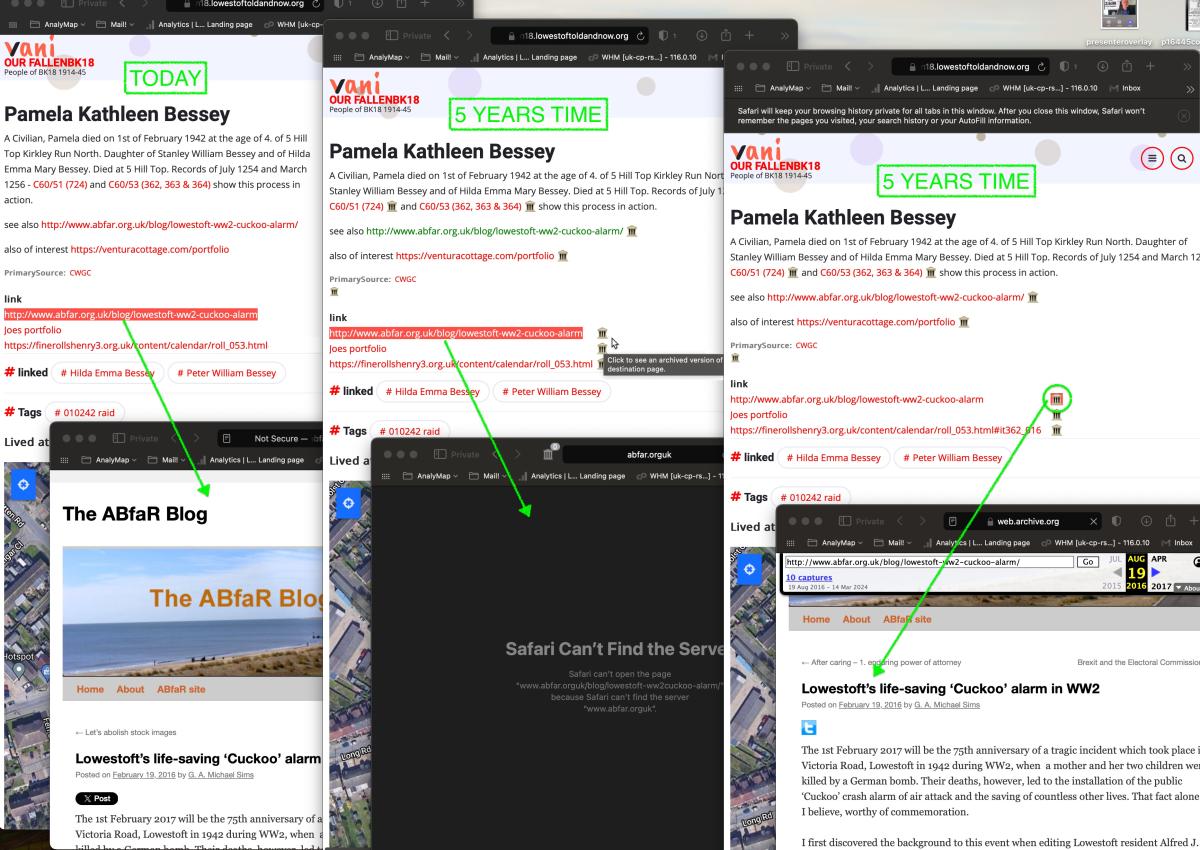
The example pictured above comes from the Our Fallen record for Pamela Kathleen Bessey, a four-year-old Lowestoft girl killed during an air raid in February 1942.
Among the sources on her page was an external article about Lowestoft's wartime “Cuckoo” air-raid warning system.
When the Our Fallen page was created, clicking the source took you straight to the original article.
Some years later, that website disappeared.
Ordinarily, our carefully recorded source would now lead the next researcher to nothing more useful than “Safari Can't Find the Server.”
But alongside older external links on Our Fallen appears a small archive symbol.
Click it and something rather wonderful happens.
Instead of asking today's internet for the page, it asks the Internet Archive's Wayback Machine for a preserved version from around the period when our page was created.
And there it is.
The missing article comes back.
Designing for five years' time — and fifty
This wasn't something added merely to fix broken links. It reflects a much bigger idea behind the project.
When building Our Fallen we have repeatedly tried to ask not only:
“Does this work today?”
but:
“Will this still make sense to somebody who finds it years after we're gone?”
That changes the way you build a historical website.
A citation isn't much use to the historian of 2046 if all we've preserved is a link to a page that disappeared in 2029.
The Drupal system underlying Our Fallen therefore uses a small open-source module called Wayback Filter. On older pages, the software can automatically place an additional Wayback Machine link alongside external links.
The reader still gets the original source first.
But if that source has disappeared — or, importantly, has changed — there is another route back towards the evidence that existed when the research was undertaken.
Why this matters
This may sound like a rather clever solution to a rather technical problem.
We think it is more important than that.
Our Fallen contains the results of thousands of individual pieces of research. Much of that research depends upon other people's work: national archives, specialist websites, local historians, newspaper articles, family-history resources and countless smaller collections.
We cannot guarantee that all of those resources will remain online.
What we can do is preserve the trail.
And that is fundamental to the way we think a community-history project should work.
Don't simply tell the next historian what you discovered. Give them the opportunity to see why you believed it.
They may discover something we missed. New records may become available. They may even establish that we were wrong.
That's fine.
History isn't strengthened by making ourselves impossible to question. It is strengthened by leaving enough evidence for the people who follow us to question us properly.
A small piece of a much bigger idea
One of our ambitions for Our Fallen is that what we've learned in Lowestoft should eventually be useful to other communities wanting to preserve their own history.
Some of the lessons are about research. Some are about photographs, mapping and storytelling. Others are surprisingly small pieces of technology such as this one.
The clever part wasn't ours.
Wayback Filter was developed within the Drupal open-source community specifically to tackle the problem of disappearing and changing web sources. Its underlying idea is beautifully simple: rather than allowing an old external link to become a dead end, give the reader another route towards the version that once existed.
That fitted almost perfectly with what we were trying to achieve.
Because preserving history isn't only about saving photographs, names and stories.
Sometimes it means preserving the footnotes.
Going Deeper
For those interested in the technology behind this, our system is deliberately made up of two separate parts: preserving the evidence when we use it, and helping future visitors find that preserved evidence later.
Capturing what we saw
During research, the browser we use is configured with an extension that automatically submits pages we visit to the Internet Archive's Wayback Machine.
That matters because an external source isn't necessarily permanent. A page may disappear completely, but it can also remain at exactly the same web address while its contents are changed.
When we create an Our Fallen record containing an external source, part of our normal workflow is to visit and check that source. The browser extension therefore helps ensure that a snapshot is deposited with the Internet Archive at around the time we relied upon it.
This gives us something more valuable than simply knowing that a website once existed.
It can preserve the version of the evidence that we actually saw.
Finding it again
The second part happens within the Our Fallen website itself.
Our Fallen is built using Drupal, an open-source content-management system. We use a Drupal module called Wayback Filter, developed specifically to help address the problem of links becoming useless as the web changes.
Importantly, Wayback Filter is not itself creating our archived copy. Its job is at the other end of the process: helping a later reader get back to material preserved by the Internet Archive.
On older Our Fallen pages, an archive symbol can appear beside an external source. If the original link has stopped working — or perhaps now leads to something different — the reader can use that additional link to look for an archived version from around the relevant period.
The complete process
1. A fact is researched and verified.
Information can come from families, archives, newspapers, websites, local historians and many other places. Within Our Fallen, it is checked before becoming part of the published historical record.
2. The source is recorded.
Rather than simply making a statement, the Our Fallen record includes the source wherever possible. This allows another researcher to understand why we reached the conclusion we did.
3. The external source is visited and checked.
As part of our research workflow we visit the source itself. Our browser setup helps submit a contemporary snapshot of the page to the Internet Archive.
4. Our Fallen retains the original citation.
The live external link remains available to readers. If the original source is still there, that is where we want them to go first.
5. Years later, Wayback Filter provides another route.
If necessary, a future researcher can follow the archive symbol towards a historical snapshot of the source.
None of this guarantees that every external source will survive forever. Digital preservation doesn't offer that sort of certainty.
What it does is improve the odds considerably — and, importantly, it does so as part of the ordinary research workflow rather than relying upon somebody remembering to preserve everything years later.
Why we think this belongs in the template
This is one of the less visible pieces of Our Fallen that we believe could be particularly useful to other community-history projects.
It doesn't require every future project to use precisely our technology. Browser extensions will change. Drupal modules will change. The Internet Archive itself will evolve.
The principle is more important than the particular software:
When recording a historical claim, preserve not only the source reference but, wherever practicable, a contemporary snapshot of the source itself — and give future researchers a way of finding it.
That turns citation into something more durable.
A researcher finding an Our Fallen page in 2046 shouldn't merely be told that in 2026 we found evidence on a website.
Where possible, they should be able to see the evidence we saw.
Further reading
Preserving the Web: How Drupal's Wayback Filter Uses the Internet Archive to Mend Broken Links — The DropTimes
https://www.thedroptimes.com/55408/preserving-web-how-drupals-wayback-f…
Wayback Filter — Drupal.org
https://www.drupal.org/project/wayback_filter
United Kingdom
Add new comment