When the Future Historian Is You
Preserving the past - Twice!
Some 26 years after we created the 22 Villages community history website, I decided to revisit it with a very particular question in mind.
The website was created at a time when the practical constraints of putting photographs and artwork online were very different. Bandwidth was limited, screens were smaller and every extra kilobyte mattered. Images that seemed perfectly adequate for the web at the time were therefore often saved at dimensions which look tiny today.
A typical full-size image on 22 Villages is only around 600 pixels wide.
That presented an interesting experiment. We now have technology capable of enlarging an image to several times its original dimensions while attempting to retain and interpret the information within it. Could that be used not to reinvent these old images, but to make material preserved on an early community-history website more accessible and appreciable to future generations?
The workflow
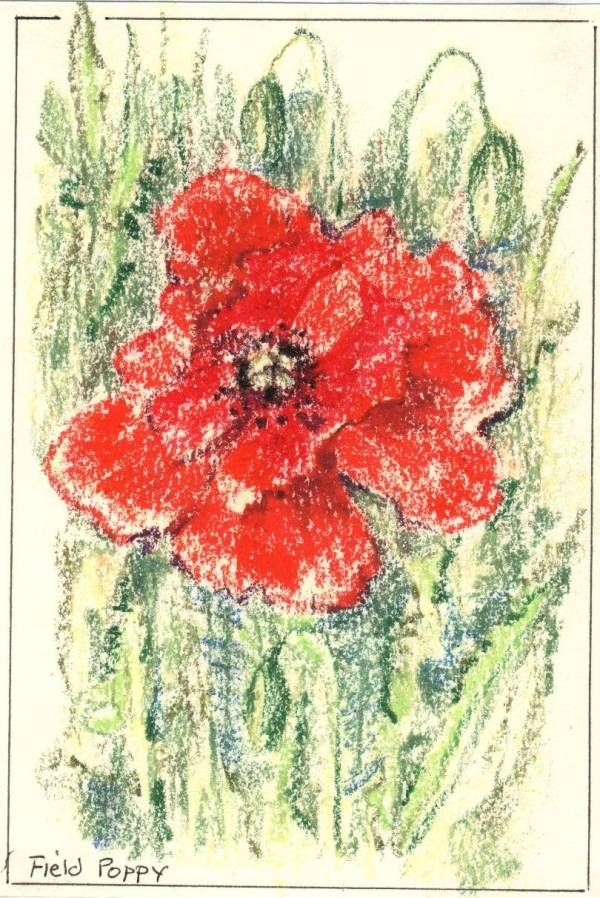
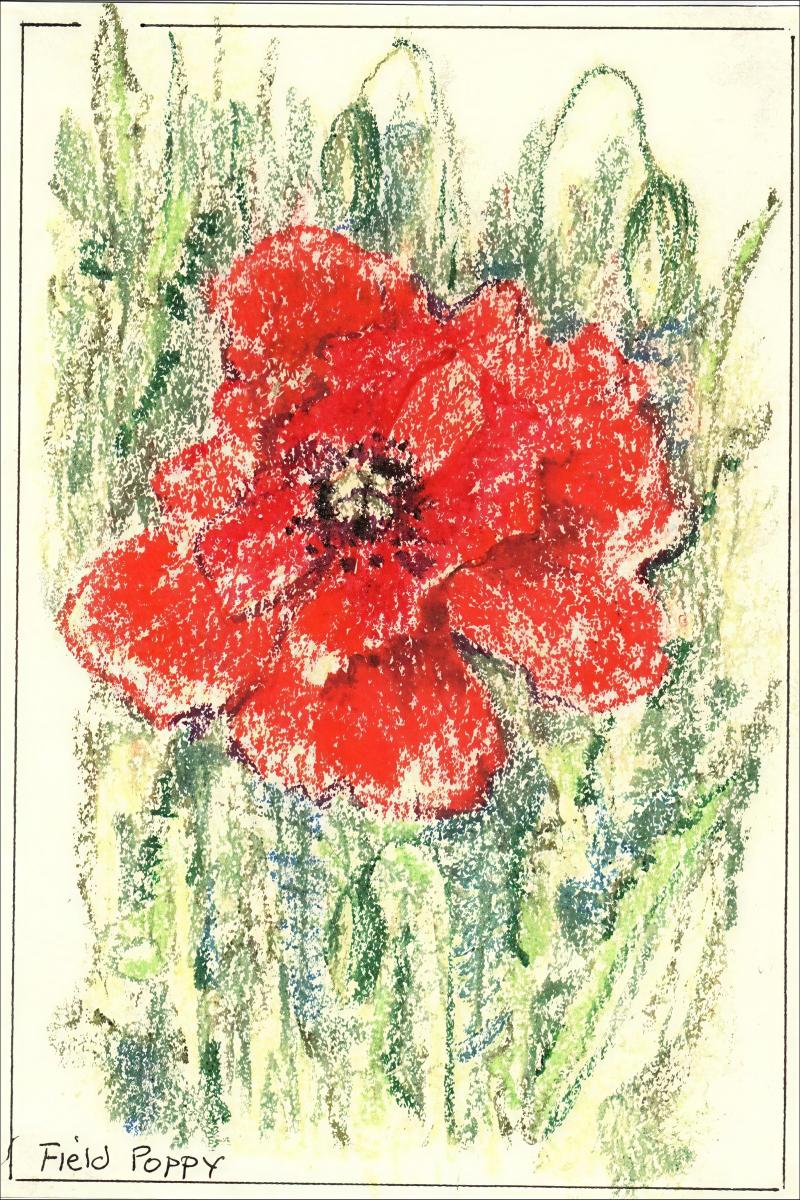
I deliberately chose a fairly typical image from the site rather than searching for one particularly likely to produce an impressive result: a drawing entitled Field Poppy.
The process was simple.
I found the original full-size image preserved on the website, measuring approximately 600 × 900 pixels. I then used modern image-scaling technology [credit: pixelCut ] to enlarge it to roughly four times its original dimensions, producing a version of approximately 2K × 3K.
I retained the original file unchanged.
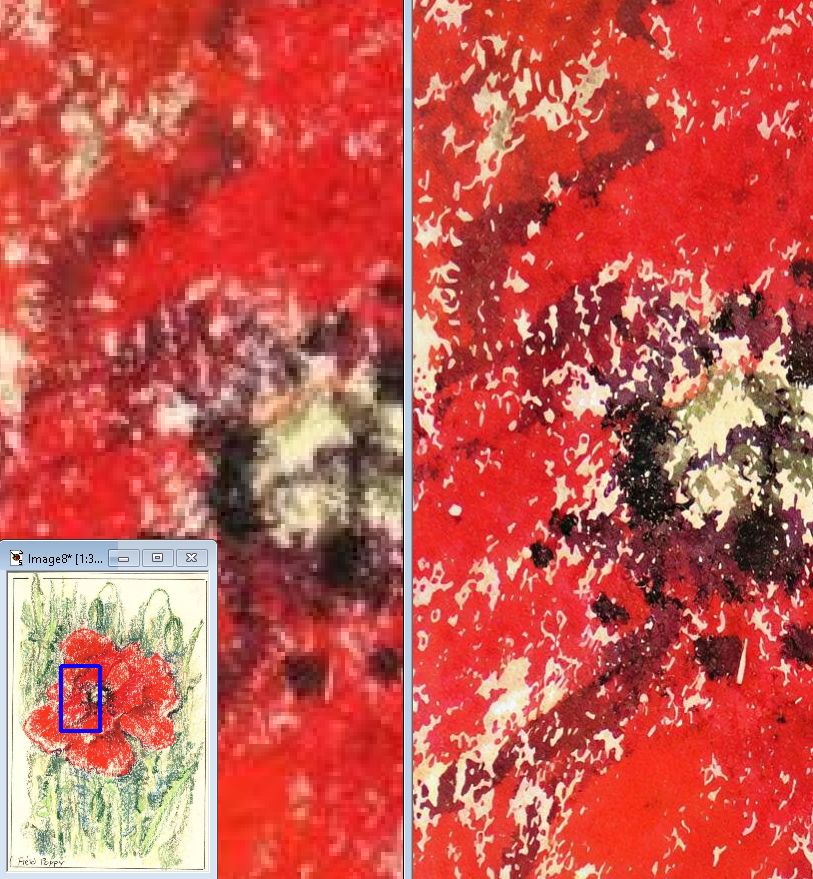
I then examined the enlarged image at normal viewing size before making a much closer comparison of a small section around the centre of the flower. That comparison was important. Simply producing a file containing more pixels proves very little. I wanted to know whether the process had actually made the original work easier to appreciate — and, equally importantly, whether it had changed its character in doing so.
What did we actually gain?
The close comparison is perhaps the most revealing part of the experiment.
The original image is already an interpretation of reality — pastel, crayon or paint rather than a photograph. At its original digital resolution, the sampling itself has become part of what we see. Enlarge it conventionally and individual pixels begin competing with the artist’s original marks.
In the enhanced version, much of that digital obstruction disappears.
Suddenly I can read the little broken cream marks, the dark strokes around the centre and the variations within the red as physical artistic marks rather than pixel noise.
Crucially, the process has not turned the poppy into a slick new illustration. At normal viewing size, the 2K × 3K version still feels completely like the same slightly rough, handmade original.
The irregularity survives.
For me, that is an important test.
There is also a fascinating difference between this experiment and our work restoring historical photographs for Our Fallen.
With a historical portrait, invented detail could change someone’s face and therefore alter the evidence. We have consequently developed a deliberately conservative approach: identity and historical evidence come before producing an attractive image.
With Field Poppy, there is no hidden photographic information for the software to “recover”. What we are principally trying to preserve is the character and topology of the artist’s marks.
That means I am comfortable allowing rather more interpolation, provided we always retain the original 600-pixel file as the archival source and identify the larger version as an enhanced derivative.
Twenty-six years is a long time on the web
The experiment also made me realise that something rather more interesting is happening here than simply improving an old image.
Around 2000, we were working within the practical constraints of web delivery at the time. A 600-pixel image was perfectly rational when bandwidth, storage, screens and browsers dictated what could sensibly be published.
Twenty-six years later, the original physical artwork may or may not still exist.
But that little 600-pixel web image does.
It has itself become historical evidence.
In effect, I find myself carrying out digital conservation on material that my younger self helped put online more than a quarter of a century ago.
And that leads to a much bigger question about 22 Villages.
It would be fascinating to look again at what we were trying to preserve, the assumptions we made about future visitors, which technical decisions have survived 26 years, what has unexpectedly become valuable and what has been lost.
Then we can turn the telescope around.
What are we doing with Our Fallen in 2026 that someone in 2052 will be grateful we did — and what will they curse us for not preserving?
There is something wonderfully strange about realising that I have unexpectedly become one of the future historians that the people creating 22 Villages were preparing material for.
Except, inconveniently, I was also one of the people creating it.
With grateful acknowledgement to team member Dave Bayer for his editorial blue pen
See also
https://22villages.manystories.org/
https://22villages.manystories.org/dalham22/hedgetotfeb27.htm
United Kingdom
Add new comment