
Interior Décor, Fittings and Possessions (Houses, 16th-18th Century)
Lowestoft Houses – 16th-18th Century
The most commonly mentioned items of interior decoration during the later part of the 16th century, in the houses of the merchants and the better-off tradespeople and craftsmen, are stained or painted canvas cloths. These served to decorate the walls on which they hung and they probably also served as draught-inhibitors. They were present in bedchambers, as well as in halls and parlours, but no indication is given as to whether they had scenes depicted upon them or whether they were simply covered in patterns. None of the 17th century documents makes reference to them, which may reflect their going out of fashion or could simply be the result of vagaries in the surviving records.
A few of the merchants’ probate inventories also refer to pictures of one kind or another. For instance, John Grudgfild had the following items in his hall when the assessors did their work on 10 March 1590: a table of the Ten Commandments, set in a frame and with a silk curtain, three framed tables of arms [coats of arms], an escutcheon [arms-bearing shield] and a framed picture. William Rogers had a framed picture in his parlour (30 April 1595) and Richard Wells a table of the Ten Commandments, also with a curtain, in his hall (4 August 1587). Obviously, Old Testament authority meant something to two of these people and one of them may have had an interest in either heraldry or genealogy.
There are only four references to pictures in the 17th century probate material. When the worldly goods of John Gleason, the vicar, were appraised on 2 July 1610, among the objects itemised in the parlour were six small pictures and a map. Much later on, on 9 December 1669, Riches [Richard] Utber (retired admiral) had four pictures hanging in the hall and four in the parlour – one of the latter being a portrait of Charles II. On 18 August 1682, Elizabeth Pacy (merchant’s widow) had a total of thirteen pictures hanging in both hall and parlour, while the inventory of her next-door neighbour, James Wilde (merchant), which was compiled on 14 March 1684, refers to nine: three each in the hall, parlour and hall chamber. It is to be regretted that the appraisers did not see fit to provide detail as to the subject-matter.
By the 18th century, pictures of one kind or another were well established as a feature of internal decoration. Out of a total of forty-two appropriate inventories which have survived for the period 1700-1730 (there are forty-six documents altogether, but four make no mention of rooms), twelve refer to them – and while the hall and the parlour were the commonest rooms in which they were hung, they were also found in kitchens and bed-chambers. In one case (that of Michael Thurston, mariner – 5 February 1714), an exotic feeling is imparted in the reference to the two “Indian pictures” which were present in his kitchen chamber and which had perhaps been acquired by him on voyages abroad.
A religious theme is touched upon in the will of Deborah Ashby (14 December 1727). She was the widow of a local merchant (Thomas Ashby), and among the numerous items she left to her maidservant, Frances Sherrington, were two small pictures depicting Joseph and his brothers and Christ’s entry into Jerusalem. In addition to this pair, she also bequeathed to Elizabeth Landifield, the daughter of a cousin, three pictures which hung on or near the chimney-breast of her main living-room: a still-life of fruit (17th century Dutch?), the Salutation of the Blessed Virgin Mary and the story of Esther.
Whether all the pictures referred to in the various documents were oil paintings or not cannot be determined. The only specific reference to prints is to be found in the inventory of Margaret Durrant (brewer’s widow), 11 December 1716. Three framed pictures and six prints are listed among the items present in the hall. The inventory of her husband, John, which had been drawn up the previous year (18 November 1715), merely itemises “divers pictures” in the same room. In some cases, the number of pictures present in a room tends to conjure up images of walls covered in High Victorian fashion. John Hovel (victualler) – 7 December 1710 – had ten in his parlour and Robert Baker (customs officer) – 23 June 1716 – had twelve in his. Even if they were not particularly large, they would certainly have made their presence felt in visual terms.
Only one surviving example of painting directly onto interior walls seems to have survived in Lowestoft, though it was common throughout the whole country from the late medieval period down to the middle of the 17th century. This is to be found in the present-day Nos. 43-44, High Street, a mid-late 16th century merchant’s house, which stands gable-end onto the roadway and which was encased during the second half of the 18th century and given a new façade during the first half of the 19th. The plaster on the chimney-breast of the middle room on the first floor is embellished with a New Testament text, dating from the Jacobean period and surrounded by a semi-foliate border. The words are a variant of James 1. 22-24: “Be ye doers of the word, and not hearers only…” The earliest reference to this building in the manor court records occurs in March 1628, when Simon Fifield (merchant) bought it from the widow and son of John Thedam, citizen of London.
During the late 16th and early 17th centuries, there are a few examples of oak wainscot panelling inside a house featuring among the bequests made by a testator. Among the various items left by James Myhell (merchant) to his son Thomas on 3 June 1584, in what is now No. 27, High Street was all the seelinge in the house. Four years later, on 20 August 1588, Roger Hill (merchant) left the seelyng in the parlour to his third son, Edmund – a legacy which is referred to in the accompanying inventory as “joined seeling of oak” (the house in question being Nos. 31-32, High Street). Then, on 1 December 1610, Richard Berye (yeoman) left “all the selinge” in one of his houses to a nephew, the latter to inherit this property after the death of the widow. Such legacies are not unknown in England at this time. But as the 17th century progressed, and more and more people had panelling fitted in their houses, the woodwork became regarded as a permanent fixture and was no longer handed down in the same way.
The same is true of window glass, which was also treated at one time as a portable item because of its relatively high value. Plus the fact that glass in its lead mountings was easily transportable and was valued sufficiently to be included among movable goods, until the early 17th century. There is only one instance in the surviving Lowestoft probate material of its being bequeathed and it is, again, to be found in the will of James Myhell. In the same clause that mentions the bequest of wainscot panelling to his son, there is also a reference to the handing down of “all the glass in the windows”. The town had at least one glazier among its working population during the second half of the 16th century (Edward Jones, whose marriage was registered on 13 November 1597), and the growing popularity of window glass throughout the 17th is perhaps best reflected by the fact that, during the last quarter, there were three of them plying their trade. And, in each half of the century, there was at least one plumber occupied in making the lead channelling into which the glass fitted.
It may well be that, as wooden shutters gave way to glazing in the windows of houses, curtains began to be used for the purpose of screening. There are five references to window curtains in the Lowestoft inventories and all of them are to be found relating to the houses of substantial people. It has been observed elsewhere that curtains were usually to be found in the dwellings of merchants and manufacturers (though not necessarily the wealthiest) and that their presence seems to have been a matter of personal taste rather than custom. Roger Hill had window curtains hanging in his parlour (16 September 1588) and Margaret Couldham (merchant’s widow) had them in the hall when the list of her worldly goods was made on 12 January 1585. A century later, three more references to them occur in the contents of the parlours of Admiral Riches Utber (9 December 1669) and merchant James Wilde (14 March 1684), and in the hall, hall chamber and kitchen chamber of Elizabeth Pacy (18 August 1682).
A final item of domestic embellishment worthy of mention is the flower pot. A number of these are itemised in the late 16th and early 17th century inventories, but they do not appear in later documents. Whether this represents a change in fashion, or whether the vessels had become so common that they became incorporated in some such standard phrase as “other old lumber” or “other old things”, is uncertain. Suffice it to say that their presence in houses was a feature that manifests itself between about 1580 and 1610. They were mainly to be found in the houses of the merchants, but not exclusively so. Margaret Rumpth (cordwainer’s widow) had one in her hall (23 January 1593) and Ralfe Bache (blacksmith) had two of them in the hall chamber (December 1603, date not known). The hall was the room in which they were most commonly located and the material from which they were made was either pewter or laten (brass). No information exists, unfortunately, to show whether they were used to hold cut flowers or live plants.
Furniture
The late 16th and early 17th century wills and inventories are full of references to joined tables, framed tables, buffet stools, settles, forms, great chairs, backed chairs and benches. The terminology does not vary across the occupation groups, merely the quality of the pieces owned and their condition. It is noticeable in the more modest income groups that the word “old” is used much more frequently to describe the various items of furniture in the different rooms. Such comfort as there was tended to be provided largely by cushions, made of silk or tapestry work, but the presence of such articles was concentrated in the wealthier sections of society. The same is true of carpets. These were used to cover tables, not lay on floors, and their presence in houses is usually an indication of the status of the inhabitants.
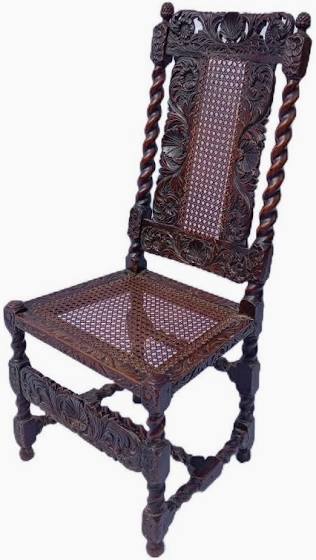
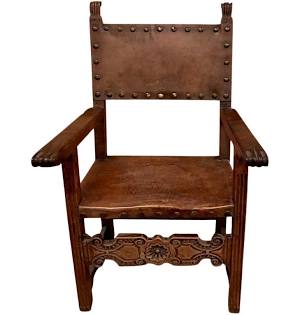
As time went on, changes in taste and fashion occurred. Benches and forms diminished in number until, by the 18th century, they are hardly ever mentioned – and stools also decreased, though not to the same extent. Chairs became the main means of seating and developments in the materials of manufacture are to be seen. By the 1670s, it is evident that wealthier people were furnishing their halls and parlours with chairs upholstered in leather (Spanish leather from Cordoba being especially valued) and the material continued to be used as the years went by, becoming available to a wider cross-section of society – not to the point, however, of reaching the ranks of craftsmen or lesser tradespeople, in whose inventories leather-work chairs never feature. during the later 17th century, cane was beginning to enjoy a vogue and chairs with seats (and backs) made from split and interwoven lengths of this occur from time to time in the inventories. So do those with segging bottoms, the reference here being to a cheap substitute for cane made of sedge – a material that was widely available in Lowestoft from the edges of Lake Lothing and from the less well drained areas of heath. It is worth noting, perhaps, that James Wilde (merchant) had two cane chairs in his parlour, when the inventory of his possessions was compiled on 14 March 1684.
Bedsteads were a notable and expensive item of furniture (often the most valuable of all individual household goods) and had their own hierarchy. Best of all was the carved and panelled, posted type, which only the wealthy people could afford to own, with its curtains and (until the fashion changed during the 17th century) its painted tester (panel resting on the four supports above). A bedstead of this type, together with its bedding and coverlets, could be worth as much as £5 or £6 during the later 16th century. Next came the livery bedstead, a solid and well-built object but without the decorative quality of the grander sort. There was then a range of utilitarian models, some posted and some not, and some half-headed, which seem to have been worth about £1 5s 0 to £1 10s 0d, with the bedstead itself valued at anything between 6s 8d and 10s.
The bottom of the range was reached in the trendle or truckle bed. This was often used for children and servants and might conceivably have been stored during the daytime by being pushed underneath a larger bedstead in the same room. The value of this type was about 2s or 3s for the bedstead itself and perhaps up to £1 for the bedding, depending on quality. Bedsteads of all kinds were covered by a variety of mattresses, featherbeds (flock was sometimes used on the cheaper ones), bolsters, pillows, sheets and coverlets. The standard varied, according to the financial means of householders, but it was high in affluent homes, with bed-linen of excellent quality and with tapestry-work coverlets to provide a sumptuous finishing touch.
Storage inside the houses was provided by a variety of chests and cupboards, as well as by closets from the late 17th century onwards. Chests usually contained linenware, clothing and valuables and were to be found mainly in chambers. Some of them were made from oak wainscot and from elm, but softwood grew in popularity from the late 16th century and there are frequent references to spruce chests, fir chests andDanske chests. Danske is an archaic form of “Danish”, suggesting Scandinavian origins, but it and spruce might also refer to North German origins of the time (specifically, Dantzig and Prussia – with the former now known as Gdansk, located in Poland).
These became less frequently referred to as the 17th century progressed, until in the later years their presence in houses was no longer noted. Chests were still mentioned from time to time, but with no details concerning the kind of wood from which they were made. The only type which is individually specified (especially after 1700) is the sea-chest, which was usually to be found in the chamber of a mariner’s house. One possible reason for the decline in the number of household chests listed is the development of the chest-of-drawers as a specialist piece of domestic furniture, because this item begins to appear during the last quarter of the 17th century.
Free-standing cupboards of one kind or another were usually located in the main downstairs rooms. The livery cupboard is the one which tends to be individually named (it was customarily used for the storage of food), whereas the other ones which appear in the documents appear to be classified according to their size in such phrases as “a great cupboard” or “one small cupboard”. Those people who were sufficiently well off to be able to afford drinking-glasses kept them stored in a box or cabinet called a glass keep. A number of these feature in inventories between the 1580s and the first decade of the 18th century, but they do not appear among the contents of houses below the level of the merchant fraternity and the better-off tradespeople, craftsmen and mariners. They were usually located in halls or parlours, but there are also occasional references to them in the contents of chambers. In one case – the inventory of Elizabeth Pacy (previously referred to) – the word belcony [balcony] is encountered, meaning a shelf of some kind on which glasses were kept.
By the early years of the 18th century, dressers begin to appear in kitchens and parlours to provide storage-space for plates and other crockery and utensils, thereby endowing the houses in which they were found with a reference recognisable today. Specialist items of what may be termed “culinary furniture” occur at either end of the period of study. During the late 16th and early 17th centuries, salt-boxes make their appearance among the various effects listed in halls, while a hundred years or so later spice-boxes begin to feature among the objects recorded in both halls and kitchens.
One piece of furniture that was present in houses from the mid-Elizabethan period right through to Georgian times is the mirror or looking-glass. To begin with, only merchant families seem to have owned them and they were usually placed in halls or parlours. One exception is Wyllyam Barrett (barber), who (not surprisingly) had one in his shop as well as in his hall: probate inventory, 4 March 1589. Their exclusiveness in relation to the wealthier levels of society seems to have prevailed throughout the 17th century (James Wilde, merchant, had five in his house, in 1684: one each in the hall, parlour, kitchen, hall chamber and parlour chamber), but the first thirty years of the 18th show that they had become more widely available and were proliferating within individual houses. Out of the forty-six inventories which are extant for that period, twenty-seven have at least one looking-glass itemised among the household contents – and some of the documents show two or three per dwelling. Even Thomas Clarke (mariner), whose possessions were valued at only £11 4s 9d (3 November 1715), had one among his goods and chattels. Halls, parlours and kitchens were the rooms most commonly associated with mirrors, but there are also examples of them being placed in chambers, too.
Domestic equipment
The most common of the items chosen to feature in this sub-section is the warming-
pan, which was used to air bed-linen and to make the bed itself more inviting to get into during the colder months of the year. It appears in both wills and inventories from the 1580s onwards and, like the looking-glass, gradually became used by a wider cross-section of the population as time went on. There seems to have been no special place where it was kept and its presence is referred to in various downstairs rooms and in chambers. The metal from which the object was made is only mentioned once: there was one made of laten (brass) in the kitchen of Ambrose King (merchant) when the inventory of his possessions was taken on 13 November 1597.
There is more information regarding chamber pots. Pewter seems to have been the most common material of manufacture early on and, again, it seems to have been the larger and better-appointed houses which had them. The rooms in which such receptacles are listed do not necessarily correspond with the places of use! They simply show where the vessels were stored – including kitchens and butteries. From the middle of the 17th century onwards, the wealthier members of society in Lowestoft began to acquire imported ones from the Rhineland – made of good quality blue and grey stoneware, generically known as Westerwald – and a number of their sherds were found in archaeological work which took place to the rear of Nos. 74, 75, 76, 77-79 and 80, High Street during 2003. Full reports of this activity (in which the writer was involved) by Paul Durbidge – Field Officer of the Lowestoft Archaeological & Local History Society – can be found in the organisation’s Annual Reports 36 (2003-4) and 37 (2004-5).
Whatever material they were made from, the periodic disposal of chamber pots’ contents is popularly supposed to have been a somewhat haphazard affair – a notion which would seem to be borne out by a leet court minute of 1706. David Cudden (husbandman) was fined 3d for throwing urine (matulas) out of the window of his house into Rant Score. He was probably disposing of the contents of a chamber pot and he may have been unfortunate enough to have done it (unless the action was deliberate!) at such time as the court jurors were passing his house. The leet itself was held at an inn in the town on the first Saturday in Lent and the previous day was spent by members of its jury on a tour of inspection, with various arraignable offences being duly noted and complaints received.
Close-stools were the other means of accommodating the calls of nature within the house and such items of furniture have been variously noted in Norwich, King’s Lynn and Exeter. They also occur fairly regularly in the Lowestoft inventories – especially in the late 17th and early 18th centuries. Altogether, there are three references to them between 1585 and 1603, a further eight between 1656 and 1693 (two of which mention the pan, as well as the seat), and ten between 1700 and 1730. Again, they seem to have been associated with the wealthier members of the community, though their wider ownership during the first three decades of the 18th century meant that they were no longer exclusive to the merchant fraternity – a customs officer, a mariner, a cooper and a mason all being included among the owners. Close-stools always feature among the contents of chambers, which is probably where they would have been used, and the earliest one of all in the Lowestoft documents is referred to twice. It was one of the many possessions bequeathed by Allen Coldham (merchant) to his wife Margaret on 20 November 1581 and he specifically refers to it as having a lock. Just over three years later, on 12 January 1585, it was listed in the said Margaret’s inventory among the contents of the shop chamber, with a value of 6s 8d placed on it.
The last piece of domestic equipment to be discussed is the coal-burning range, which seems to have been an introduction of the early 18th century as far as houses in Lowestoft are concerned. It is first mentioned on 12 June 1706, in the will of Frances Canham, a widow, who bequeathed one to her grandson, Thomas Daines. This suggests that it was both removable and portable, which in turn implies an iron fabrication of some sort. There are five references to coal ranges in the probate inventories, the first being that of John Hovel (victualler), who had one in his kitchen, which was worth 10s with its accompanying implements (7 December 1710). Leake Bitson (merchant), who lived in the most northerly house on the east side of the High Street, had one in his kitchen and another in his parlour when the appraisal of his goods was made on 25 February 1717. They were each valued at 12s. Robert Dixon (carpenter) also had one in his kitchen. His house stood on the south side of Blue Anchor Lane (later, Duke’s Head Street) and his inventory of 11 February 1723 gives a value of 13s for the range and its implements. Samuel Smithson (merchant), who lived at the western end of Bell Lane (later, Crown Street), died later in the same year and the assessors valued the range in his kitchen at 25s (19 June). Finally, on 29 December 1730, the possessions of Samuel Baker (customs officer) were appraised. He had a range in both kitchen and parlour, the former being valued at £1 10s 0d and the latter at £1 1s 6d.
Clocks and watches
There are no means of telling the time in-house earlier than 11 February 1642, when an hour-glass was listed among the possessions of Christopher Rant (gentleman) – and another turned up sixty years later, on 6 May 1701, in the effects of George Mayes (fisherman). Rant lived in a High Street house on the southern corner of the score bearing his family name and also held the five dwellings between his own residence and that belonging to the Wilde Family at what is now No. 80 High Street. There are no references to mechanical time-pieces in the Lowestoft probate material earlier than December 1677.
The first one appears in the inventory of Richard Church (merchant) – 21 December 1677 – who had a case-clock standing in his hall, worth £3. Nearly five years later, on 18 August 1682, the clock and case belonging to his mother-in-law, Elizabeth Pacy (also in the hall), were valued at £2. In the same month and year, her next-door neighbour, James Wilde (merchant), bequeathed the clock in his hall to his oldest son, John, and on 14 March 1684 this same clock was valued at £2 10s. 0d. in his inventory. Finally, in January 1693 (date not known), the inventory of Simon Rivett (mariner) shows that he too had a clock standing in his hall. No case is referred to and the instrument’s value cannot be ascertained because of damage to the document. There is only one probate record of the late 17th century which refers to a watch and that is the will of James Reeve (doctor), who bequeathed one to his wife on 4 February 1679. It was obviously not in working order, because the testator described it as requiring repair by a Mr. Manley of Beccles.
During the first thirty years of the 18th century, clocks appear in probate inventories in thirteen of the forty-six surviving documents (though two of them do relate to the same dwelling, being the lists of goods of a brewer and his widow) and watches in another four. Seven of the clocks were situated in halls, three in parlours and three in kitchens. Nine of the references are to clocks alone and another four to clocks and cases. Where individual values are able to be ascertained (sometimes the items were included with other household goods in a composite sum), the range is from £1 to £4 10s 0d, regardless of whether the clock had a case or not. The ownership of these clocks is as follows: three merchants, a brewer and his widow, a grocer, three mariners, a customs officer, an innkeeper, a mason and a farmer. The five watches recorded belonged to another customs officer (brother of the man who owned the clock), a merchant, a mariner, a cordwainer and a widow previously mentioned. The customs officer owned two watches, each with a chain, and that belonging to the cordwainer is described as being made of silver. Most valuable of all, however, was the one which belonged to Deborah Ashby (previously mentioned earlier with her ownership of religious pictures) and which she bequeathed to her four-years-old nephew-by-marriage, Thomas Mighells, on 14 December 1717: it was made of gold and set with diamonds.
Books
A total of forty inventories, out of the hundred available for study, reveal the ownership of books, and this 40% of the whole matches what was found by Nesta Evans – back during the 1970s – in her study of the South Elmham area of rural Suffolk. Both percentages are higher than the upper limit ascertained in a national study of literacy during the pre-industrial period and considerably in excess of what has been identified in Cambridgeshire. There are far fewer references to books in the Lowestoft wills, with only fourteen documents out of 507 mentioning them. It is interesting to note, however, that twenty-one of the inventories which show the presence of books in a house have accompanying wills – and nowhere in the latter documents are books referred to. This was usually the result of individual testators handing over the bulk of their respective estates to one main beneficiary, without referring to the separate items that constituted them.
The books which are mentioned in wills are nearly always Bibles or religious works of some kind and they were valued sufficiently by their owners to be accorded the honour of individual bequest to relatives or friends. Among the religious titles encountered are the inevitable John Foxe’s Book of Martyrs (sometimes said to be the most encountered book in the country, after the Bible) and either Thomas Bilson’s The Perpetual Government of Christ His Church or his Effect of certain Sermons concerning the Full Redemption of Mankind by the Death and Blood of Jesus Christ. Deborah Ashby, the widow noted earlier for her bequests of pictures with a religious theme, showed a similar propensity in her reading matter. She left her maidservant, Frances Sherrington, a Bible, five volumes of Mr. Sibbs’ works and The History of the Saviour, and a male cousin, Ashby Utting, was to receive two volumes of Poole’s Annotations. It is to be hoped that each of them shared her apparent taste for didactic theological works! Richard Sibbs (1577-1635) was a Puritan divine, who wrote books of sermons; Matthew Poole (1624-1679) was an Anglican minister of Presbyterian leanings, who produced Biblical commentaries.
The forty inventories which record the presence of books in people’s houses also show a slant towards the Christian religion, with thirteen references to Bibles. In seventeen cases, books (of whatever kind they were) were located in halls. Three of the documents make no reference to rooms of any kind, but the remaining twenty indicate the use of most other rooms in houses of the time as a location for books: parlour (two), kitchen (five), buttery (one), study (one), living room (one), shop (one) wash-house (one), chamber (five) and lodging room (three). Occasionally, a specialist volume associated with the owner’s occupation comes to light, such as the wagginer listed among the possessions of Admiral Riches Utber on 9 December 1669 – which was a book of navigational charts, the original one having been compiled by a Dutchman, LucasJanssen Wagenaer, and first published in 1584. But, for the most part (with the exception of Bibles), no identification or titles are given.
This is to be regretted because there are collections of books which, if individually named (or even given generic classification), would provide an idea of people’s reading tastes or areas of interest. John Gleason, the vicar had £4 worth of books in his study (2 July 1610) and sixty years later (15 November 1671) John Collins, a young gentleman in his twenties, who had recently qualified in law at Emmanuel College, Cambridge, had eight folios, twelve quartos and ninety small books in his lodging chamber, worth a total amount of £11 5s 0d. A decade or so later, next-door neighbours Elizabeth Pacy and James Wilde, who have already been referred to a number of times in this chapter, had forty books (worth £3) and “a library of books” (worth £5) in their respective halls. In May 1691 (date not known), Robert Knight – a gentleman from Kent, who had married into the influential Mighells family – had books worth £10 in a chamber, and the final collection of any note is that belonging to Michael Thurston (5 February 1714). He was the mariner, noted earlier as having exotic pictures in his kitchen chamber. Below them, in the kitchen itself, were twenty books worth 7s 6d.
Weapons and armour
Far from being the rarities that they were found to be in a study of villages of the time in rural Cambridgeshire (by Margaret Spufford), weapons of various kinds are mentioned a good deal in the Lowestoft probate material. Nor was their presence in houses anything to do with creating an impression on people entering a dwelling – as was the case with some of the grander Norwich residences during the second half of the 17th century. Their existence was very much due to practical reasons. Coastal communities tended to be seen as the nation’s first line of defence against foreign invasion, especially during the Elizabethan period, when the threat from Spain was at its greatest. Then there was the need for seafarers to have the means of fending off attack from privateers, especially those from the Dunkirk area. Altogether, thirty-one of the Lowestoft inventories make reference to weapons of one kind or another, a proportion which again corresponds closely with what has been observed in the South Elmham part of rural Suffolk mentioned four paragraphs above. Of these thirty-one documents, eleven date from the last fifteen years of the 16th century and five from the early years of the 17th. By way of contrast, only four of the 507 wills have weapons referred to – a much lower proportion than that ascertained in the South Elmham area of rural Suffolk.
The concentration of weaponry in the 1580s and 90s is not surprising, given the country’s expectation of being invaded by Spain. A muster taken of Lowestoft in 1584 (the year in which the contingency plan for Lothingland – dealt with in another article – was drawn up) lists 240 men, not all suitable for military service and not all of whom had weapons. In addition, there were four widows who were able to supply equipment, which had presumably belonged to their husbands. The weapons and pieces of armour listed are as follows: eighty-four bills, five pikes, two halberds, twenty-one calivers, seventeen bows, five swords, five daggers, twenty-six corselets and coats of plate, and thirty-six helmets and steel caps of various kinds. The calivers were largely owned by seafarers and merchants and the bills by landsmen, and there are four cases of weapons referred to in the muster turning up in probate inventories. Roger Hill’s caliver and almayne rivet were listed among the contents of his hall (16 September 1588); Ambrose King’s caliver was one of two itemised in the parlour chamber (13 November 1597) – but it must have been some years since he had been able to use either of them, as he was noted in the muster list as being blind; John Gaze, a cooper, had a bill and sallet in his hall (28 July 1590); and Margaret Couldham had her deceased husband’s coat of plate stored in the shop chamber (12 January 1585).
The second half of the 17th century and the first three decades of the 18th show a continuation of the possession of arms by people involved in fishing or maritime trade, but further professional use (if it may be so termed) is evident in the ownership of swords and pistols by customs officers. Another feature concerning firearms is the use of sporting guns, which manifests itself from time to time across the whole time-span covered in this book. The earliest reference to a “fowling piece” is to be found in the inventory of William Rogers (goldsmith), on 30 April 1595. Henry Cobbe (innkeeper) had one on 10 April 1618, while Admiral Riches Utber owned three of them (as well as three pairs of pistols, a rapier and a crossbow) on 9 December 1669 – perhaps occupying some of his retirement hours in pursuit of wildfowl. The last time that sporting guns are referred to is on 21 December 1677, when Richard Church (merchant) is seen to have been in possession of one.
There would have been ample opportunity to have used such firearms on the various areas of heathland in the parish and also around the margins of Lake Lothing. Presumably, the privilege would have been been enjoyed with the lord of the manor’s permission and no cases of illegal shooting have been detected in the leet court minutes. The monetary value of firearms is hard to ascertain because they are never listed individually, but are bracketed together with other, similar guns or with associated equipment such as touch-boxes and flaskets. The nearest estimate that can be given for the earlier part of the 17th century is Henry Cobbe’s fowling piece at 16s (though a yew bow-stave also formed part of the valuation), while that belonging to Richard Church was probably worth about £2, being itemised together with a musket in a valuation of £4. The usual rooms where weapons were kept were either the hall (sixteen examples) or the parlour (six examples), though chambers (five examples) also feature as places of storage.
Precious metal
Altogether, eighty-three of the 507 Lowestoft wills mention bequests of silverware and other valuables. At 16.3% of the whole, this is broadly comparable with the South Elmham area of Suffolk. Specific items are not always referred to, but a standard phrase used, such as “all my gold, silver, jewels and plate”. The inventories, however, show in detail the kind of precious objects which people had in their houses and they also draw attention to the way in which, by the first three decades of the 18th century, the possession of silver had spread across a broader cross-section of society. Out of the 100 inventories available for study, no less than forty-nine record artefacts made from precious metal (mainly silver), which is twice the rate of ownership as that observed in South Elmham. Presumably, the greater visible affluence in Lowestoft was the result of its being a community involved in fishing and maritime trade, as well as in agriculturally-based pursuits – as opposed to one that was primarily concerned with agriculture alone.
Usually, household silver was located in halls and parlours and consisted mainly of items associated with the table. In the late 16th century, because of the number of their inventories which have survived, members of the merchant class are seen to have had goblets, cups, salts and spoons in their homes (some of the vessels being silver-gilt), as well as buttons made of silver. The latter are listed as if independent of garments, so perhaps they were awaiting use. There are also references to silver-rimmed mazers and stone cups and, occasionally, a touch of real personal luxury is noted in something like the reference to Roger Hill’s gold comb and silver toothpick (16 September 1588).
During the mid to late 17th century, a similar range of items is to be seen in the ownership of merchants, the more affluent tradespeople and members of the gentry. The one development in domestic silverware to be noted is the presence of tankards (almost certainly with lids) among people’s prized possessions, while in terms of the metal generally the word “plate” starts to be used to describe a range of items. Richard Utber had 378 ounces of it in his house, as well as “sundry rings and jewels”, the total value of these assets being assessed at £114 10s 0d – by far the largest sum recorded in any of the inventories. Next in the overall hierarchy, though a long way behind, comes James Wilde. He had three tankards (one of which had been presented to him by the town for his efforts in leading the opposition to Great Yarmouth’s attempts to control the local herring industry), a salt cellar, a porringer, a cup and nineteen spoons – all of which were valued at £35.
During the first thirty years of the 18th century, twenty-nine of the forty-six inventories reveal the ownership of silverware. The social range was wider than it had been previously, with craftsmen and fishermen joining the ranks of those who had items made of silver in their homes. The pieces themselves were broadly the same as they had been for the previous hundred years or more, consisting largely of cups, tankards, salts and spoons. Six references to plate are to be found, as a means of summarising the deceased’s silverware, and the most valuable collection was that of Margaret Durrant (brewer’s widow, 11 December 1716). Her pair of silver tankards, a salver, a cup, two salts and twelve silver spoons were estimated to be worth £25.
Most interesting of all, in social terms, is the reference to three silver tea spoons on 25 February 1717, itemised among the possessions of Leake Bitson (merchant). And they are not the only ones recorded. Thomas Felton (cooper) had one among his various effects on 9 July 1722, while Daniel Manning (cordwainer) – 29 December 1730 – had an unspecified number in his house and Samuel Baker (customs officer) had six in his – same date as that for Manning. Thus, a generation or so before the town’s soft-paste porcelain factory went into production, people in Lowestoft were enjoying the vogue for drinking tea. The single spoon referred to is likely to have been one for measuring out the amount of tea to be used, while those of increased number probably indicate stirring of the brew itself.
CREDIT: David Butcher
United Kingdom
Add new comment