
Death on the Denes (1666)
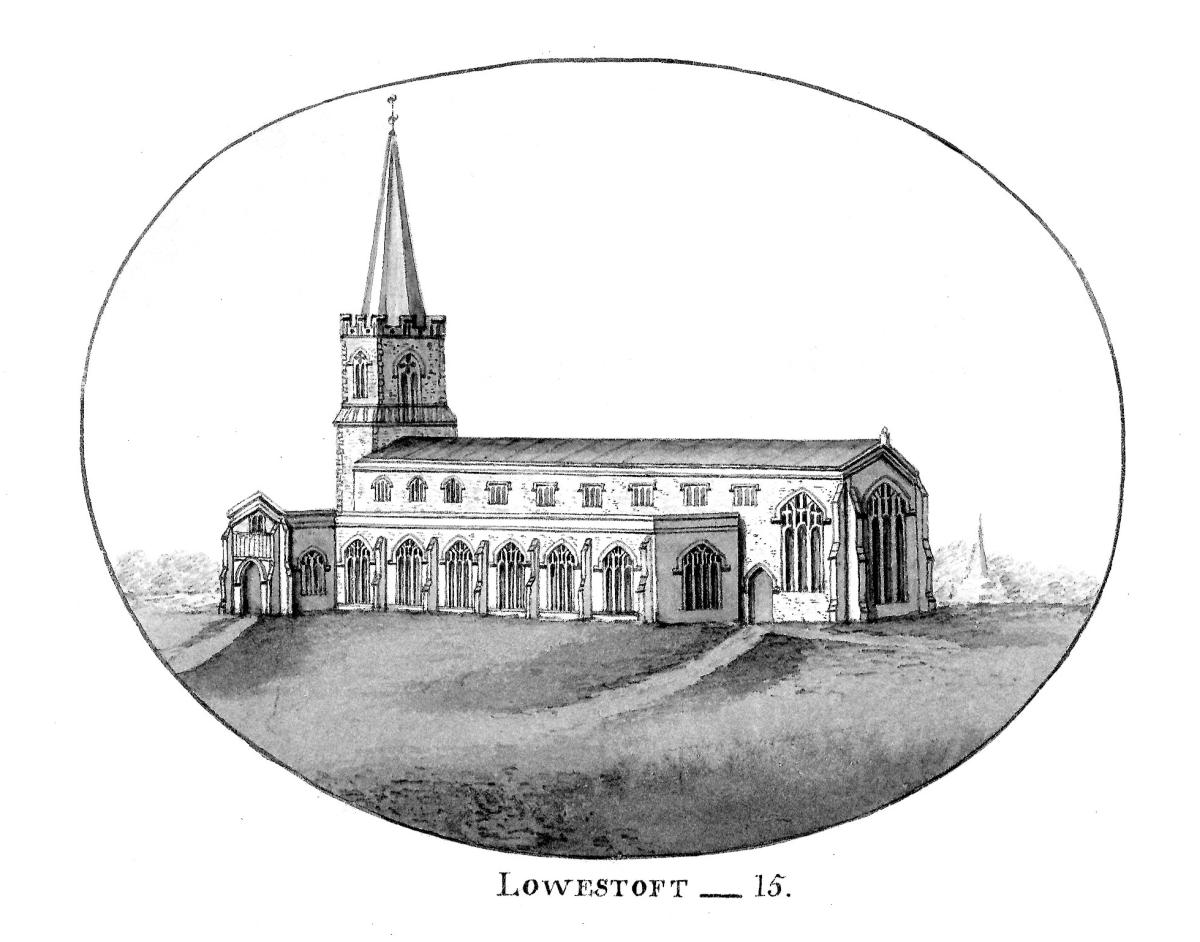
Some idea of the vulnerability of the Lothingland coastline during times of trouble may be had from an incident which occurred during the Second Dutch War (1665-67). The Lowestoft parish registers have this entry, made on 7 February 1666 [1665, in the old-style calendar]: “Maijer Thomas Willd of Yarmouth, was kild at Corton by a musket shot that went into wessan”. The grave-slab of this man is set into the floor of the middle aisle of St. Margaret’s Church, not far from the chancel screen and next to that of his parents, John and Mary Wild(e). It reads thus: “HERE LYETH BURYED THE BODY OF MAJOR / THOMAS WILDE SONNE OF JOHN WILDE / OF THIS TOWNE DECEASED WHOE WAS / SLAYNE BY THE DUTCH IN THE DEFENCE / OF HIS KING AND CONTRY THE 5 OF / FEBRUARY 1665 AFTER HE HAD / ACCOMPLISHED THE AGE OF 57 YEARES”. Edmund Gillingwater, in his An Historical Account of the Ancient Town of Lowestoft (1790), p. 422, provides further information. According to his account of what had occurred, a Dutch privateer had come close inshore and Thomas Wild(e), accompanied by several townsmen, had gone down to the shoreline North Battery (one of three gun emplacements protecting the town) to prevent the vessel capturing any of the local trading or fishing craft which were anchored up off the beach. The Dutch opened fire on the battery and Thomas Wild(e) was killed.
There is an obvious discrepancy between the two accounts regarding the location of the place of death, the parish register citing Corton and Gillingwater (writing nearly 130 years afterwards) specifying Lowestoft’s North Battery. What possibly happened is that Wild(e) and his party rode – with some members of it probably on foot, also – northwards from the battery, shadowing the movement of the Dutch vessel, and were fired upon on the Gunton/Corton denes. If it was, specifically, within the Corton parish boundary, then it would have had to be to the north of Lopham Score (now known as Tramp’s Alley). Whatever the case, the privateer must have been close in, on high tide, for the shot to have been fatal. It's a moot point as to whether it was fired from a musket. It could have been from a small culverin loaded with multiple shot and mounted on the gunwale. Whatever the case, the fatal shot hit Thomas Wild(e) in the throat – the parish register’s “wessan” being a variant spelling of weasand, an Old English word for the windpipe or for the throat generally. The parish clerk at the time of the incident, Thomas Breathet (a cordwainer), had a singular way of spelling a number of words in his register entries, based as much on local dialect pronunciation as anything else. But with spelling being flexible at the time, and as long as the meaning was clear, that was good enough.
Thomas Wild(e) himself – the final -e of the surname tending to become fixed as the usual spelling round about the time of his death – was a member of one of Lowestoft’s best known and longest associated families during the pre-industrial era. Members of it are to be found in the Lay Subsidy (a national tax levy) of 1524-5 and it died out in the main, male line with the death of John Wilde in 1738. It was by the terms of this man’s will that a boys’ free grammar school was eventually established in 1788 in buildings to the rear of the family home at what is now 80 High Street, the so-called South Flint House – a late 16th century dwelling of high quality. The school premises was situated on Wilde’s Score and is currently occupied by the Lowestoft Heritage Workshop Centre. The Wildes were great benefactors to Lowestoft over the years and it is good that their name is perpetuated in that of the score itself, next to which they lived for so many years.
Thomas Wilde himself resided in Great Yarmouth, where the family also owned property. According to Charles Palmer, in his The Perlustration of Great Yarmouth, vol. 2 (1874), pp. 24-5, the house stood on the south-west corner of Row 76, facing South Quay, not far from the present-day Town Hall. Wilde was survived by his widow and two daughters, Judith and Elizabeth. His connection with Yarmouth can be traced back as far as 1640, when a surviving marriage settlement document (a pre-nuptial contract agreement) in the Norfolk Record Office shows that he had allied himself with the town’s governing élite by marrying Judith, daughter of Benjamin Cowper, gentleman. From then on, he would almost certainly have operated as a merchant, with interests in both fishing and maritime trade. In 1648, he is named by Henry Swinden, in The History and Antiquities of the Ancient Borough of Great Yarmouth (1772), p. 573, as lieutenant in a militia cavalry force raised for the defence of the town during the English Civil Wars. Yarmouth was a Parliamentary stronghold, but Wilde seems to have come to terms with the restoration of the monarchy in 1660 and had raised his soldierly rank also. Hard military experience on his part can only be speculated on, but he was obviously trusted to carry out defensive work on behalf of the realm – and it cost him his life. Death saw him return to his native town permanently. And it is the parish church of St. Margaret, Lowestoft, as referred to above, which holds his mortal remains – not that of St. Nicholas, Great Yarmouth.
CREDIT:David Butcher
United Kingdom
Add new comment