
Inventory of James Wilde (1684) – Probate Record
(14 March 1684)
An Inventory Indented of all and singular the goods and Chattels of James Wilde late of Lowestoft in the County of Suff[olk], merchant, valued and appraised the Fourteenth day of March in the year of our Lord One Thousand six hundred eighty three by Joshua Smithson, Nicholas Utting, Robert [? ] and John Aldred of Lowestoft aforesaid, Merchants, as Followeth
In the hall
| six Russia leather chairs | |
| one table & carpet, two forms & eight cushions. | |
| two small chairs & one cushion | |
| a Clock and Case. | |
| a looking glass & three pictures | |
| a library of books. | 05 00 0 |
| a fire cradle as it stands. | |
| a parcel of arms | 03 00 0 |
In the parlour
| four Russia Chairs, two turkey work & two Cane Chairs | |
| a table, three stools, one Couch, seven Cushions & a carpet . | |
| one Chest of drawers | 01 00 0 |
| one looking glass & three pictures . | 03 00 0 |
| one fire cradle, andirons, tongs & fore-iron four Curtains with Curtain rods & a lute | 00 15 0 |
| three silver tankards, one salt, two cups, one porringer & nineteen spoons | 35 00 0 |
In the kitchen
| one fire cradle, tongs & fore-iron. | 01 00 0 |
| one Jack, with weights, & six spits . | 01 10 0 |
| a pair of steelyards & other small irons | 00 15 0 |
| one Keep & a parcel of earthen ware | 01 00 0 |
| one table & screen, ten Chairs & four Cushions | 01 00 0 |
| a looking Glass | 00 02 0 |
| four & twenty pieces of brass | |
| a parcel of pewter | 10 00 0 |
| six leather Buckets & a cupboard | |
| several small things in the pantry |
In the parlour chamber
| One bed & bedstead as it stands | 10 00 0 |
| Six chairs, one table, one stool | 01 00 0 |
| A Chest of drawers, a looking glass & two pair of andirons. | 01 10 0 |
| A parcel of fine linen | 20 00 0 |
In the hall chamber
| one bed & bedstead as it stands | 20 00 0 |
| two tables, eleven chairs & three stools | 03 10 0 |
| one Looking glass & three pictures . | 05 00 0 |
| a parcel of linen. | 05 10 0 |
| two pair of andirons & two cabinets. | 00 10 0 |
In the kitchen chamber
| one bed & bedstead as it stands. | 05 00 0 |
| one Trendle bed as it stands . | 03 00 0 |
| one trunk, one box, two chairs, one press & two stools. | 01 10 0 |
| two pair of andirons & a cushion . | 00 04 0 |
| two small baskets & a voider. | 00 03 0 |
| a bed & bedstead in the closet | 02 10 0 |
| a parcel of linen | 09 14 0 |
In the Garret
| one bed as it stands | 03 00 0 |
| one case of bottles, one trunk, three chairs & three stools | 01 05 0 |
| twelve pair of sheets | 03 00 0 |
| two beds & bedsteads as they stand | 03 00 0 |
| one table, three chests, one close stool & two chairs | 01 00 0 |
| four coverings. | 01 10 0 |
| a parcel of twine | 00 10 0 |
| Fourteen pair of sheets. | 06 00 0 |
| one bed & bedstead more. | 03 00 0 |
| one table, three chairs & four stools | 00 10 0 |
| one Chest, one trunk & one standard . | 00 10 0 |
| a parcel of Canvas | 20 00 0 |
| a parcel of strings . | 01 00 0 |
| eight pair of sheets . | 03 00 0 |
| six dozen Napkins | 01 04 0 |
| eight board cloths . | 01 16 0 |
| three dozen towels | 00 09 0 |
In the outhouses
| four Iron pots, two roast irons, two frying pans | 01 10 0 |
| two hundred paving stones | 01 10 0 |
| two coppers & one pot | 10 00 0 |
| a parcel of brewing vessels | 01 10 0 |
In the summerhouse
| Six Chairs, one table & a bell | 01 10 0 |
| twenty dozen bottles | 01 10 0 |
his wearing apparel, linen & woollen
| 15 00 0
|
| an eighth part of the ship called the Lion | 70 00 0 |
| an eighth part of the Riga merchant | 75 00 0 |
| an eighth part of the Tricon | 75 00 0 |
| a fourth part of the Ermin. | 80 00 0 |
| three sixteenth parts of the Oak | 60 00 0 |
| the Envoy. | 200 00 0 |
| the Mermaid | 140 00 0 |
| the James. | 100 00 0 |
| the Swallow. | 100 00 0 |
| the Amity | 50 00 0 |
| four Ferry boats & props | 18 00 0 |
| twenty dozen swills | 06 00 0 |
| two hundred Coombs of barley & malt | 100 00 0 |
| herring & mackerel lint. | 15 00 0 |
| two horses, two carts & one Calash with furniture | 15 00 0 |
| half a hundred deals | 01 10 0 |
| a draught net | 01 00 0 |
| eight hundredweight of rope. | 08 00 0 |
| one barrel of white herrings & a firkin | 00 14 0 |
| three spare anchors. | 03 10 0 |
| Lumber in the upper & lower houses. | 05 00 0 |
| five wey of salt | 15 00 0 |
| four thousand billet. | 06 00 0 |
- The three identifiable assessors were classified as merchants in the preamble. Only Nicholas Uttting had that occupation; Joshua Smithson was a woollen draper and John Aldred a grocer. The fourth assessor’s surname cannot be read because of imperfections in the document.
- Note that the transcription has omitted the word “Item” at the beginning of every entry and has used modern spelling, while retaining original grammatical forms and use of capital letters. Monetary values of the household goods have only been given in those cases where they could be clearly read and there was no doubt as to the amount recorded. The three column presentational style represents pounds, shillings and pence (£ s d).
- The inventory is dated 14 March 1683, by use of the Old Style (Julian) calendar, which had the New Year beginning on 25 March. James Wilde’s burial is recorded in the parish registers on 13 March and he was seventy-one years old when he died. The title here has used the New Style (Gregorian) calendar year of 1684 to conform with modern practice.
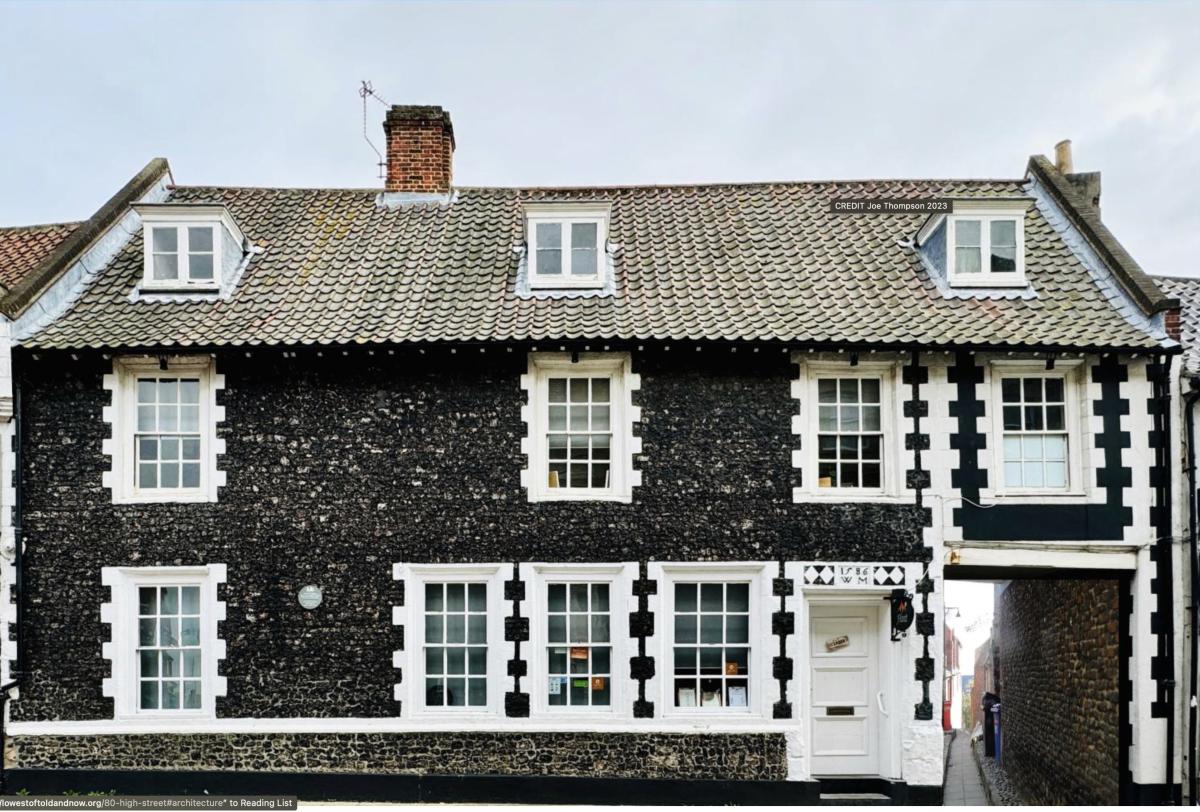
- The kitchen chamber mentioned probably included the part of the house built over the entryto the score bearing the name of the Wilde family – resulting from its having a connection of 150 years or more with the building. The footway once ran directly from the High Street down to Whapload Road, but was diverted into Cumberland Place much later on.
- The summerhouse referred to stood on the first terrace-level down from the street. After the contents (three separate entries) had been recorded, all of James Wilde’s business activities and materials were then listed. The Lion, Riga, Tricon, Ermin and Oak were trading craft in which he had a shared interest at varying levels; the Envoy, Mermaid, James, Swallow and Amity were fishing vessels belonging to him. The Riga speaks of a well-established Baltic trade and is, of course, the name of the capital of the modern state of Latvia. At the time, what later became Estonia, Latvia and Lithuania made up a country called Livonia.
- The remains of the summerhouse were located during archaeological work carried out during 2001 and 2002, prior to landscaping of the garden area adjacent to the Lowestoft Heritage Workshop Centre. They consisted of a square, brick-built chamber, below ground level, with plastered interior walls – a cellar of sorts, which presumably had the summerhouse itself set immediately above. Considerable numbers of late seventeenth-century wine bottle fragments were also found – some of which, at least, may possibly relate to the “twenty dozen” bottles referred to in the inventory.
- The table and chairs listed in the summerhouse were obviously for recreational use and the bell (presumably, a hand-bell) employed for summoning servants, as and when needed. But what were all of James Wilde’s clothes doing there? His wife had obviously had a quick clear-out following his decease and used the summerhouse to store them. Two possibilities for this are either his dying from something infectious, with consequent removal of particular personal effects, or the widow’s desire to distance herself (in her loss) from items intimately connected with her husband.
- The six main rooms of the house, listed in the document above, now have the following uses in a restaurant conversion carried out there during the early 2000s: the hall and parlour form the bar area; the kitchen is occupied by the toilets; the hall chamber and parlour chamber constitute the dining-space; and the kitchen chamber is the kitchen itself.
- The determining factor in the internal layout was (and still is) the large, off-centre chimney-stack, which provided a heating and cooking facility in four of the rooms (it would also have warmed the attic for the people living there). Another, smaller stack on the end wall of the house, next to the entry-way to the score, would have done the same for the other two.
- The roof-space was used for servant accommodation and general household storage.
- The inventory above is held in the National Archives: ref. PROB/4/12299. A copy is also currently lodged in the Lowestoft branch of Suffolk Archives.
- James Wilde was a considerable benefactor to the town in a number of ways. With the help of his cousin Samuel Pacy – who lived next door at what is now Nos. 81-83 High Street – and Thomas Mighells (fellow merchants), he spearheaded Lowestoft’s attempts during the early 1660s to rid itself of Great Yarmouth’s long attempted suppression of its maritime tradeand herring fishing activity. Edmund Gillingwater in his An Historical Account of the Ancient Town of Lowestoft (1790), pp. 114-245, records the whole process in great detailand includes a lengthy reproduction of the accounts, kept by Wilde, of the expenses incurred in fighting the case in Parliament – totalling £308 18s 8d in all (pp. 221-39). On the very last page regarding these is the reference to a silver tankard (almost certainly lidded, in the fashion of the time) presented to him “by the inhabitants of Lowestoft, for the good services they believed I did them in defending their privileges against Yarmouth, beginning in 1659 and ending in 1663”. This memorial gift would, of course, have been one of the three silver tankards recorded among the contents of the Parlour.
- Perhaps the most tangible sign of James Wilde’s service to the town, as things stand today, is much of the Sparrow’s Nest gardens area and the former Churchwarden’s cottage which forms part of the Lowestoft & East Suffolk Maritime Museum. When he died in February 1684 (1683, by the Old Style calendar), he had left £50 in his will of 7 August 1682 to be used as thought best by his widow, children and the leading townspeople for the benefit of the poor. This bequest took the form of the gift of twelve penny-loaves of bread (standard size), to be given out each Sunday after morning service to those in need. The annual sum of £2 12s 0d needed to finance this was raised from the rent deriving from a dwelling-house and land situated on Whapload Road, with the building preceding the one seen today (this dating from the early 19th century) becoming known as “James Wilde’s bread house”. The will was written by the man himself.
CREDIT:David Butcher
Glossary
andirons: fire-dogs (a pair of metal stands used to support logs in a hearth).
arms: weapons and armour.
billet: a small split section of ash or oak, used for curing red herrings.
board cloths: tablecloths.
calash: a light, two-wheeled carriage used for personal transport.
carpet: usually imported from Turkey and used to cover a table - not the floor.
case: indicates that the clock was probably an early long-case type.
close stool: a commode.
coomb: a measure of grain amounting to four bushels. A coomb of barley weighed sixteen stones; malt would have been lighter.
deals: softwood planks (usually pine, spruce or fir).
draught net: a draw net (a small, hand-operated seine).
ferry boats: rowing craft used to convey goods to and from vessels at anchor. Often used also in longshore fishing, particularly during the autumn herring season.
fire cradle: a square or rectangular iron basket, with legs, to stand within a hearth.
firkin: a cask of nine gallons volume. A herring barrel was thirty-two gallons.
fore-iron: a small spit used for roasting in front of an open fire.
furniture: equipment, gear.
jack: an oscillating, clockwork device for turning a spit above an open fire.
keep: a small, closed cupboard; a safe.
lint: drift-net mesh.
lumber: odds and ends; items of no great worth.
napkins: serviettes.
parcel: a quantity or amount.
porringer: a small, two-handled bowl or cup.
press: a linen press.
props: oars.
“Riga” merchant: a vessel engaged largely in Baltic trade.
Russia leather: highly rated for its quality and durability.
salt: a silver dish for containing salt, used at the table.
screen: a portable wooden barrier to act as prevention against draughts.
standard: either a tall wooden candle-holder or a large packing-case of some kind.
steelyards: weighing balances, with horizontal arms and counter-weights.
swills: baskets used for washing herrings after they had been salted.
trendle bed: a small, low bed which could be pushed underneath a posted bed. Often used by servants.
turkey work: tapestry or raised embroidery.
voider: a basket or container for plates, cutlery etc.
wey: forty bushels; one ton by weight.
white herrings: fish which had been gutted and pickled in brine.
United Kingdom
Add new comment