
Lighthouse
1706 the remaining Low Light ceased operation, possibly because "...the sea overwhelmed it..." (p97 Lights of East Anglia by Neville Long, 1983)
Added: 23 September, 2023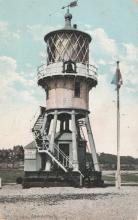
1867 A completely new Lowestoft Low Light, made of wrought iron. It was designed to be moveable.
Added: 23 September, 2023As the sandbanks shifted and Pakefield lighthouse was declared redundant and closed in 1864. The lighthouse’s 10m high tower has since been used as a war-time oservation post, store-room and holiday camp darkroom.
Added: 23 September, 20231850 Pakefield Light House moved to Kessingland because the channel had shifted. The Pakefield LH tower is still there, in the holiday centre. The light was finally extinguished in 1864.
Added: 23 September, 20231832 Pakefield Lighthouse (red light) built to help navigate through the channel between the Barnard and Newcombe Sands. The station was made of brick.
Added: 23 September, 20231832 Low Light rebuilt with brick foundation to stop it falling into the sea
Added: 23 September, 20231796 High Light fitted with "eleven Argand burners set in the focus of silvered reflectors" (p102 Lights of East Anglia by Neville Long, 1983)
Added: 23 September, 20231778 A 'spangle light' was tested for one night on Lowestoft Low Light by several Trinity Elders sailing out to sea. The design was never permanently used. A many-signed letter said the new light was 'constant, certain and regular', and seen from a greater distance than the coalfired light. In February 1779 a 'small reflector was ordered to be fixed to a triangle or beacon'. In September 1779 '...a Mr Smith was paid £6.5.o for a plated reflector, lamp and fountain'.
Added: 23 September, 2023